Every hospitality environment has its own unique rhythm. In a busy hotel lobby or a high‑volume bar, the guest’s priority is often speed and efficiency. In a luxury restaurant or a boutique stay, that same guest expects a personal connection and a conversation that cannot be replaced by a screen. The challenge for modern operators is choosing technology that supports their specific environment rather than forcing a one‑size‑fits‑all solution that risks compromising the brand.
Meeting the guest at their own pace
In environments where turnover is the primary driver, digital ordering has moved from a temporary measure to a permanent operational advantage. The benefit is simple: the faster an operator can serve, the quicker the guest receives their order. There is no waiting for a member of staff to become available; guests can sit down, scan, and begin their experience in seconds.
Beyond speed, there is a psychological advantage to digital prompts that goes beyond a simple list of items. Whether it is a beautifully photographed side dish or a premium room upgrade, a well-placed visual creates an immediate, visceral reaction.
“Suddenly [the guest] gets prompted, ‘Do you want to add fries to it?’ and they’re not just being told, they can see a beautiful picture of fries in a basket. Suddenly it’s like, oh, salivating, I want to order that.”
Leveraging technology in high‑touch environments
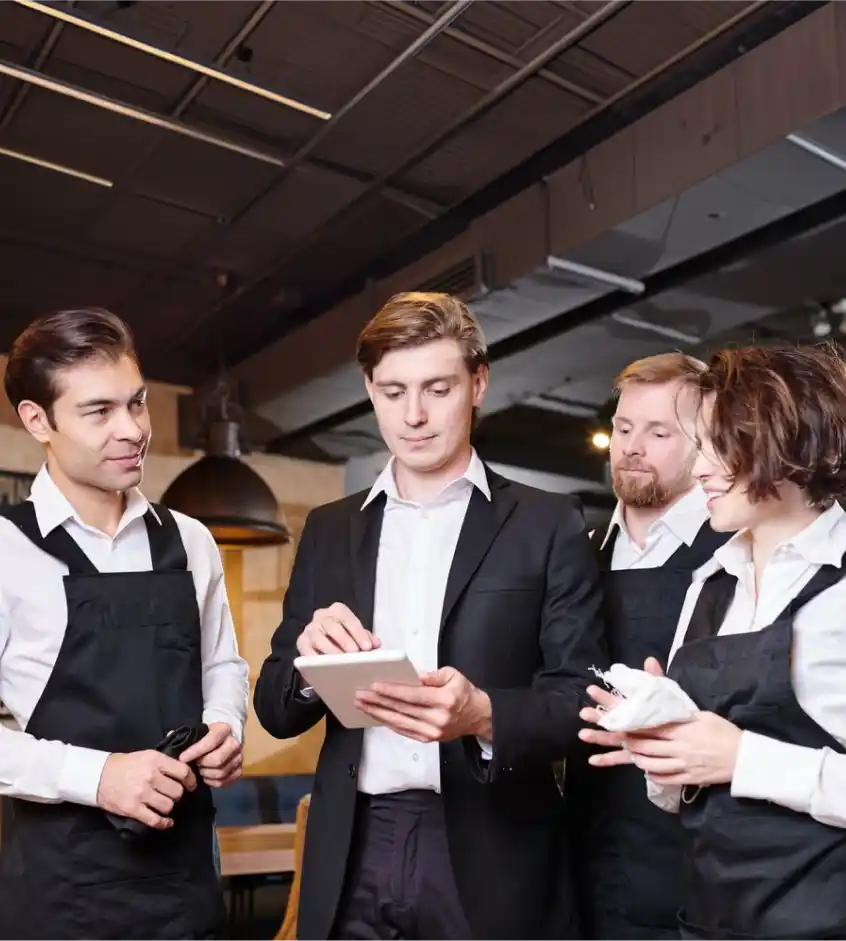
Many premium sectors stay away from guest‑facing technology because they value the personal interaction that defines their brand. However, this does not mean they have to avoid digital tools entirely. In these settings, the same logic of upselling and efficiency can be leveraged through mobile devices in the hands of the staff.
The technology prompts the server or concierge rather than the guest. It puts real‑time knowledge in their hands, allowing them to discuss the menu or amenities with confidence while the order is sent to the backend instantly. This keeps the team fully present with the guest, blending personal service with the efficiency of a digital infrastructure.
“The server has that knowledge in their hands to be able to discuss this with their customer and prompt those upsells… so it goes off to the kitchen while they are still chatting with the customer.”
Support as an operational consultant
Choosing the right technology is only half the battle; the other half is having a partner who understands the operation behind the screen. At NFS, our operations team comes from the industry, which means they can see behind the simple questions.
Whether you are running a high-volume bar or a single-site restaurant, our team speaks your language because they have lived it. They understand that a second saved at the terminal is a second gained with a guest. Support at NFS is not just about fixing problems; it is about identifying operational bottlenecks. We help you refine your service flow, ensure your kitchen isn’t overwhelmed by digital spikes, and give time back to the people running the floor.
“Having the operations team come out of the industry helps with that because they are able to see behind the customer’s question… a question that looks so simple can turn into a whole conversation about what they’re actually trying to achieve.”
Always discovering the next move
The best technology does not just sit on a counter; it evolves with the business. Whether it is using a hybrid model where guests order with a server but pay via a digital code or optimising your service layout to reduce travel time for staff, the goal is always the same. We aim to make the life of the operator easier, give them their time back, and ensure they have the tools to meet the ever‑changing expectations of their guests.
“With NFS, support is there to not only fix problems but also help identify areas in which we can improve the customer’s operation. How can we help them interact with their customers better? How can we give them some time back?”
Ready to find the right balance for your service?
If you are looking to improve your speed of service or want to give your team better tools for guest interaction, let’s start with a conversation. We will help you align your tech with your unique brand culture and ensure your operation is ready for the road ahead.
Contact the NFS team today to schedule your service style review and see what happens when your tech partner truly understands your operation.
Walk into almost any hotel today, and you’ll see a familiar scene – a POS terminal fixed to the bar, another in the restaurant, and a workstation tucked behind the lounge. These are the last traces of the till era, still bolted to counters even as the hotel around them has moved on. Staff move between them constantly, weaving through service like they’re following choreography written years ago. Guests wait to sign bills or confirm room charges, and managers try to make sense of what’s happening across the property using systems that don’t speak to each other.
Meanwhile, the guest journey has changed dramatically. A guest might start with breakfast, grab a coffee in the lobby, order lunch in a meeting room, enjoy drinks on the terrace, dine in the brasserie, and finish the night with room service. They move freely, and they expect the hotel to move with them.
“The hotel POS isn’t dying. It’s simply outgrowing the role it used to play.”
The age of the till has passed, and hotels are stepping into the era of the connected ecosystem. The POS is no longer a counter‑bound device; it is becoming the engine that holds the modern hotel together.
The real issue: hotel technology built in silos
For years, hotels built their technology one system at a time. A PMS for rooms, a POS for F&B, a separate platform for events, another for loyalty, another for payments, and another for inventory. Each system worked well enough on its own, but none were designed to work together.
The result is something every hotelier recognises – duplicated work, repeated guest questions, slow handovers between departments, and a sense that technology is adding friction rather than removing it. Guests don’t care which system does what. They don’t see the plumbing behind the scenes.
“Guests don’t see systems; they see one hotel. And they expect it to behave like one.”
That expectation is reshaping the role of the POS more than any hardware trend ever could.
The shift: from till to hotel-wide operational engine
The POS is no longer just the place where orders are keyed in; it is no longer a till at all. It has become the connective tissue of the hotel ecosystem, the system that understands guest preferences, tracks spending, connects to the PMS, handles payments, and gives managers a real-time view of what is happening. It is the difference between a tool and a nervous system.
A modern POS can quietly orchestrate the flow of service, sending orders to the right prep station, reducing walking time for staff, and smoothing out room-charge workflows so they feel effortless rather than awkward. It can help managers spot issues before they escalate, whether that is an understaffed bar, a meeting room running ahead of schedule, or a menu item that is suddenly trending.
When the POS is connected properly, it becomes the foundation for practical AI, helping teams make better decisions by forecasting demand, highlighting guest preferences, guiding purchasing decisions, and getting new staff up to speed faster.
“This isn’t the death of the POS. It’s the evolution of it, from a till on a counter to the intelligent engine that quietly powers the entire hotel.”
Why this evolution is happening now
Hotels are being pushed forward by forces that can’t be ignored. Guests expect to order, pay, and personalise their stay on their own terms, without losing the human touch. Labour is harder to find and more expensive to retain, F&B margins are under pressure, and managers need real-time visibility, not yesterday’s reports.
At the same time, the old idea that the PMS should do everything is fading. Hotels are moving toward ecosystems, choosing best-in-class systems that integrate cleanly rather than relying on one platform that tries to be all things to all departments. The till era was built on single systems; the ecosystem era depends on many systems working as one. In that world, the POS becomes the anchor – the system that quietly keeps everything connected.
How hotels are responding
The hotels that are getting this right aren’t simply replacing hardware; they’re rethinking how their teams work. Mobile devices are replacing fixed-terminal bottlenecks so staff can take orders anywhere without breaking the flow of service. Guests can pay how they want, when they want. Data is being used to personalise service in ways that feel natural rather than intrusive. The technology doesn’t replace hospitality; it gives staff more time to deliver it.
Real-time data and intelligent insight
One of the biggest shifts is the move from reactive reporting to real-time insight. When the POS is connected to the PMS, inventory, payments, and workforce systems, managers can finally see what is happening as it happens. Margins update automatically as ingredient costs change, server performance becomes visible in the moment, menu items can be adjusted based on live demand, stock can be reordered before it runs out, and labour can be matched to forecasted occupancy and outlet activity. This data helps hotels make better decisions faster.
Integration as a competitive edge
Hotels used to purchase systems based on features, but now they buy based on how well those systems integrate. A POS that doesn’t talk to the PMS creates friction, a POS that doesn’t talk to payments creates errors, and a POS that doesn’t talk to loyalty or events creates operational blind spots.
The hotels that win are the ones whose systems behave like one ecosystem rather than a collection of disconnected tools. This is where supplier collaboration matters, and it is where NFS has built its reputation.
Why NFS leads this shift
Hotels don’t need another system; they need a partner who understands how their operation really works, including the pressure points, the guest expectations, the financial realities, and the rhythm of service that no piece of software can see on its own.
NFS has spent years inside hotel operations, not just selling technology but shaping it around the way real teams work, communicate, and serve. We don’t arrive with a product pitch. We arrive with questions, curiosity, and a commitment to building an ecosystem that fits the hotel.
With NFS, you don’t just get technology – you get a partner invested in your success.
Looking ahead
The future hotel POS won’t sit on a counter. It won’t be something guests notice or staff think about. It will sit quietly at the centre of the ecosystem, powering every interaction, every decision, and every moment of service.
As Luis DeSouza, CEO of NFS, says:
“The till may be dead, but the hotel tech ecosystem it gave rise to is now indispensable. The hotels that embrace this shift will deliver the most seamless, most human, and most memorable guest experiences both now, and in the years ahead.”
“And this will deliver lower operating costs and staff better equipped to focus on the guest.”