It’s 2:30 am, the tills are down, and the venue is still full.
Guests are still ordering, the team is trying to keep service moving, and suddenly part of your tech stack isn’t doing what it should. Every minute it takes to resolve the problem puts more pressure on the team and risks disrupting the experience you’ve worked so hard to create.
So, who are you going to call?
At 2:30 am, you don’t want to start working out which part of the tech stack is responsible, or which supplier owns the problem. You need someone who understands how everything fits together, takes responsibility, and helps get you back up and running. That’s when the difference between having suppliers and having genuine partners becomes clear.
When nobody quite owns the problem
Most venues have experienced the frustration of an issue that doesn’t sit neatly in one place. One provider looks at their part of the setup, another looks at theirs, and someone within the business is left joining the dots.
As Rob Woolford from BrewDog explains:
“We have had our EPoS systems crash and fail on us, and what NFS were great at was trying to list down everything that could be wrong and ruling it out. They worked through the night to provide us with an update the next morning.”
It’s not just about being available
Out-of-hours support is one thing; knowing what happens when you actually use it is another.
If an issue involves different parts of your tech stack, the last thing you need is another number to call or another ticket to raise. Every minute counts, so you need someone to work out what’s happening, bring in the right people, and see the issue through.
For late-night venues, support needs to work around the hours you trade and, crucially, take pressure away from the people running the operation.
Support has to fit the operation
This is where NFS Managed Services comes into its own. It’s not simply about having someone at the end of the phone; it’s having a team that understands tech and hospitality, brings the right partners together, and takes responsibility for the wider picture. In practice, that means real people dealing with real problems, rather than leaving the operator to coordinate several suppliers when they already have enough to deal with.
When everything is working, you shouldn’t have to think about any of this. When it isn’t, you should already know who’s picking up the phone.
Late-night venues will always have their fair share of shenanigans. Chasing tech suppliers at 2:30 am doesn’t need to be one of them.
If you’re looking at how your tech could reduce operational pressure, support a better customer experience, and give your team one less thing to worry about, let’s have a chat.
If it ain’t broke, why fix it? When it comes to hospitality EPOS, if a system is familiar, reliable, and gets the job done, there’s little appetite to change it. What is changing, however, is the pressure hospitality businesses face.
Rising costs, increasing customer expectations, ongoing staffing challenges, and tightening margins are forcing operators to look more closely at every part of their operation. As a result, many are starting to ask a different question.
“Is our technology helping us meet the challenges facing the business today?”
The conversation has changed
Only a few years ago, technology conversations often centred around functionality. What can it do? What features does it have? How does it compare to what we have today? Those questions haven’t disappeared, but they no longer dominate conversations.
Instead, operators are more focused on outcomes. Can technology help control costs? Can it support teams more effectively? Can it improve visibility across the business? Can it create a better customer experience? Perhaps most importantly, can it help the business grow without adding unnecessary complexity?
Discussions have shifted from what technology can do to what it can help a hospitality business achieve.
Making every pound work harder
Cost pressures are one of the biggest challenges facing hospitality operators today. Margins remain under pressure, labour costs have risen, and operators are under constant pressure to do more with less, which is why visibility from your hospitality EPOS has become so important.
Whether it’s understanding menu performance, monitoring stock levels, identifying opportunities to improve margins, or gaining a clearer picture of day-to-day trading, operators want access to meaningful information that helps them make better decisions.
I’m also hearing more questions around visibility. Operators want a clearer picture of what’s happening across the business, whether that’s stock levels, menu performance, margins, or day-to-day trading. They’re not necessarily looking for more systems; they’re looking to get more value from the information they already have.
“NFS does help us a lot with back office, understanding our percentage of staff labour costs, our percentages of goods against sales and how to judge staff and labour for each night based on various weeks, months, and years of trading. All that gives us a better idea on how to run our business on a day-to-day basis.”
Steve Lewis
Efficiency without compromise
Staffing challenges have become a fact of life for many hospitality businesses, making operational efficiency more important than ever.
The most successful operators aren’t simply asking teams to work harder; they’re looking for ways to remove unnecessary effort from the day-to-day operation.
Simple tasks should be straightforward, and new starters should feel confident using the systems quickly. Teams shouldn’t be relying on workarounds or duplicate processes just to get through a busy shift, and managers shouldn’t be spending valuable time dealing with avoidable frustrations.
The best technology is the technology that barely gets noticed; it simply helps teams do their jobs more effectively.
Customer experience drives loyalty
Guests and customers have more choices than ever before. Whether they’re booking a hotel stay, visiting a restaurant, or stopping for a coffee, they expect the experience to be smooth, efficient, and consistent. Technology doesn’t create loyalty on its own; it does, however, support the experiences that encourage people to return.
Reducing friction, improving speed of service, supporting staff, and helping businesses deliver consistently positive experiences all play an important role in building loyalty over time. Customers don’t come back because a venue has great technology. They come back because it consistently delivers a great experience.
More than a hospitality EPOS system
I’ve sat through plenty of technology demonstrations over the years, and they’re often impressive, but the conversations that happen afterwards are usually much more interesting.
Operators are rarely discussing features alone. They’re asking whether the system will fit their business, whether teams will use it, whether support will be there when it’s needed, and whether the technology can evolve alongside the operation as it grows.
Hospitality businesses are looking beyond software alone. They want confidence that their systems are working together, and that support is available when needed. That’s where the conversation often moves beyond technology and towards partnership.
Helping hospitality businesses thrive
At NFS, we’ve always believed that technology is only part of the picture. The most successful hospitality businesses aren’t simply investing in software. They’re investing in the right technology, the right partners, and the right support to help them achieve their goals.
Whether the priority is managing costs, improving efficiency, strengthening customer loyalty, enhancing the customer experience, or supporting future growth, technology should be helping operators move forward rather than creating additional complexity.
Operators also want confidence that the technology they invest in today can support the business tomorrow, whether that means opening new sites, introducing new services, or adapting to changing customer expectations.
Because at the end of the day, nobody gets into hospitality because they’re passionate about technology. They do it because they’re passionate about people, service, and creating great experiences. The best technology simply helps them focus on exactly that.
Many operators know their current system is no longer serving them, yet the thought of switching feels overwhelming. Change brings pressure; it feels risky, it feels disruptive. In hospitality, where every minute counts, that fear is completely understandable.
At NFS, we see this every day. That is why our onboarding process does not begin with hardware or configuration. It begins with people.
Getting to know the people behind the business
The first step in every rollout is a kick-off call. It is not a technical session; it is an introduction to the people who will be using the system. We explain who we are, what we do, and the services we provide. More importantly, we learn about your business, your team, and your confidence with technology, and this shapes everything that follows.
“Before we talk about the technology, we focus on getting to know the people. Understanding how tech-savvy your team is helps us choose the right implementation approach.”
Tailoring implementation to your comfort level
Once we understand your team, we match you to the right rollout approach. If you are confident with technology, we can support a remote install. If you are not tech-savvy or do not have IT support, we come to your site and handle the installation in person. If you are a small business where one person does everything, we take on the technical load, so you do not have to. Crucially, the way we execute the deployment is based on your experience and your wishes.
“If a team is not tech-savvy or does not have IT support, we step in and complete the installation on-site – supporting you all the way through.”
This is not a one-size-fits-all process. It is a partnership shaped around your needs and preferences
Reassurance for the moments that cause the most worry
When starting out, operators often express the same concerns. They worry about moving from an old system to a new one, how their menus will look, how payments will flow, and what will happen if something goes wrong. Downtime, internet issues, and blackouts are real fears. Our role is to reassure you that you are not facing these risks alone.
“Operators often need reassurance about downtime or internet issues. They want to know that if something happens, we are there for them.”
We provide the redundancies, the support, and the calm guidance that make the transition feel safe.
One point of contact, even with multiple systems
Hospitality operations rely on several systems working together. Integrations are essential, but they can also be a source of stress. When something goes wrong, the last thing you want is to call several providers and hope someone takes responsibility.
NFS removes that burden. Even with multiple integrations, we serve as your single point of contact. You do not need to chase different services. You call us, and we take care of it.
“Even with multiple integrated systems, you do not need to contact different providers. We act as your main point of contact and handle it for you.”
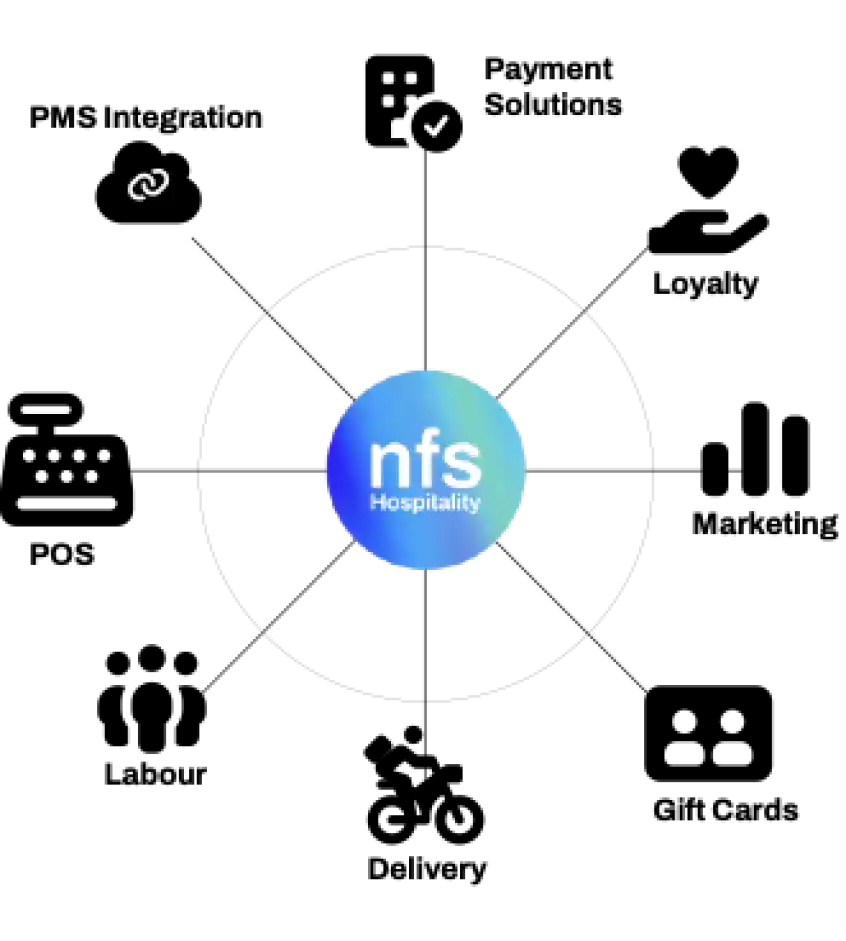
This is possible because your technology sits within a connected hospitality ecosystem rather than a set of isolated tools. By bringing your POS, PMS, payments, and integrations into one environment, we remove the friction operators often feel when juggling several vendors. Complexity stays behind the scenes, where it belongs.
Making the complex feel simple
Bringing different technologies together is challenging work, but our customers never feel that complexity. Our job is to make the transition smooth, predictable, and calm. We are a partner rather than a point-product vendor.
“We bring the technology together and make it simple.”
The strength of our hospitality ecosystem is that every component is designed to work together. This creates a seamless operational flow that continues long after installation is complete.
Ready for a partner who puts people first?
If you are feeling pressure at the thought of changing your systems, start a conversation with a team that understands the journey. We do not just deploy technology. We support the people who rely on it, and we stay with you from the first call to the final sign-off.
Contact the NFS team today to discuss your transition and see how we can build a partnership that supports your team’s unique needs.
Three decades in hospitality have taught me many lessons, but one of the most important is this: control is earned through engineering strength, operational discipline, and open collaboration, not through branding.
As the industry moves into a new era of integration, automation, and guest‑driven service, the gap between cosmetic control and real capability is becoming clearer than ever.
The illusion of control
There has been a lot said about the risks of white‑label POS. Much of it focuses on the branding itself, but branding is rarely the real problem; white‑labelling can be a sensible commercial model. The problems arise when it is used to conceal weak engineering, limited support, and a development culture that does not welcome collaboration.
Over the years, I have spoken with many organisations who were promised independence, only to discover that they were accountable for outages, unexpected updates, and frustrated operators, even though they had no ability to shape the underlying product. They were promised control yet found themselves managing the consequences of decisions they had no part in making. It is a difficult position to be in, and it is far more common than many realise.
Where things start to break
The pattern is familiar: a partner is given a branded interface, but not the ability to influence the roadmap, even when their market needs shift. They are offered initial support, but not the ongoing operational commitment required to navigate the realities of hospitality, which is why enterprise‑grade support matters so much. They are given a system that works in a demonstration, but not one that consistently withstands the pressure of a full venue, something only robust hospitality‑ready infrastructure can deliver. The branding creates the appearance of ownership, but not the substance behind it, and branding alone never creates resilience.
When a system fails, the logo on the screen offers no reassurance. What matters is whether your technology partner has the engineering discipline, the operational maturity, and the commitment to respond immediately.
What a genuine partnership looks like
At NFS, we believe that transparency is the foundation of trust. Our clients know how our systems work, how decisions are made, and importantly, how we support them. We maintain open communication, predictable release cycles, and a development process that welcomes input from the people who rely on the technology every day. We do not believe in hiding behind branding; we believe in building systems that are robust, reliable, and ready for the realities of service.
The future of hospitality technology
Looking ahead, the expectations placed on hospitality technology will keep rising. Operators are looking for systems that integrate more intelligently, adapt more quickly, and provide clearer visibility across their entire operation. They want platforms that grow with their business. They want partners who understand the pressures of service, who share their ambition, and who are prepared to innovate with them.
The next generation of hospitality systems need to be open, collaborative, and resilient. They will need to support real‑time decision‑making, seamless guest experiences, and operational efficiency. They will need to be built on engineering foundations that can withstand the pace and unpredictability of modern service.
Being present when it matters
As the industry evolves, one constant remains. When something goes wrong, operators need a partner who is present, accountable, and capable of acting with urgency.
Over the years, I have seen how shortcuts in architecture eventually become failures on the floor. They may save time in the short term, but they cost far more in the long run. Hospitality businesses deserve better than that, and they deserve partners who recognise the responsibility that comes with supporting them.
White‑labelling is not the enemy; poor engineering, limited support, and closed development cultures are. The hospitality sector needs technology partners who are accountable, collaborative, and committed to long‑term success, and systems that are built to withstand real operational pressure.
At NFS, we do not hide behind white labels.
We stand alongside our partners.
When Coyote Ugly’s payment system couldn’t keep up, NFS uncovered the truth and found an 18% saving.
Coyote Ugly knew its payment setup had some issues, but they couldn’t figure out why.
Service felt slower than it should, staff were dealing with a constant stream of problems, and the whole system just didn’t feel built for the pace of a busy bar. Then, talking with NFS, a hospitality partner who understands how venues really run, everything became clearer.
NFS reviewed the setup, uncovered the real causes of the problems, and found something Coyote Ugly hadn’t seen. They were being charged for things they didn’t need, their rates were above standard, and switching to a better solution would save them 18%. That discovery changed things in an instant because 18% isn’t just a small win; it’s money that goes straight back into the business.
The setup that wasn’t built for hospitality
Before NFS stepped in, Coyote Ugly were relying on a payment system that simply couldn’t keep up with the pace of hospitality. The network kept dropping, transactions froze mid-payment, and staff had to restart systems or move customers around just to get orders to go through. Anyone who’s worked in a bar knows how quickly these issues can derail a shift. They slow everything down, frustrate staff, and create pressure nobody needs.
The lack of integration made it worse, as staff had to key in every amount manually, adding time to every payment, and leaving plenty of room for mistakes. The one‑to‑one terminal pairing meant only one device could connect to a till at a time.
The 18% moment that changed everything
When NFS reviewed the operation, they didn’t just look at the tech. They looked at the business. They checked what they were being charged for and compared it to what they actually needed. That’s when they uncovered the 18% saving. It wasn’t just a better deal; it was a sign the venue had been overpaying for too long.
With the issues clear and the saving on the table, NFS recommended Dojo as the best solution. It was the right fit for the pace, pressure, and flow of a venue like Coyote Ugly.
How NFS and Dojo turned the situation around
Once the new system went live, the change was immediate. Payments finally kept up with service because the systems were integrated properly. Staff didn’t have to key in payments manually, which made transactions quicker and far less stressful.
They could use more than one terminal per till, which meant faster turnaround. And with automatic 4G backup built into the devices, payments kept running even when the network dipped. The whole atmosphere changed because the technology was finally supporting the team instead of slowing them down.
A hospitality partner from start to finish
NFS didn’t just recommend the solution; they delivered it. They attended site, installed the new payment setup, trained the whole team, and stayed on site for the first day of trading to make sure everything ran smoothly. The venue also gained full 24/7 support from NFS for payments, giving them a partner they can rely on whenever they need help.
The result: faster service, happier staff, and a saving that makes a difference
Since switching to the NFS and Dojo hospitality ecosystem, Coyote Ugly’s seen faster transactions, fewer interruptions, and a smoother service flow. Staff can move freely, customers get served quicker, and the payment issues that once caused stress have disappeared. Most importantly, the 18% savings are now being used where they actually make a difference.
In a market where guest expectations are shaped by their best experiences elsewhere, hospitality is no longer just about the food on the plate. It is about the friction – or lack of it – throughout the entire journey.
The brands pulling ahead aren’t just ‘using tech,’ they’ve achieved clarity – the kind that lets them move faster, stay consistent, and deliver the experience guests return for. They understand that technology only works when it is shaped around the service model, not the other way around.
By using a hospitality ecosystem where every touchpoint – from ordering and payments to loyalty and marketing – feeds into one shared source of truth, these brands have turned consistency into their greatest growth engine. And we’re proud to be supporting some of the best examples of this in the market today.
1) Dishoom: Authenticity at scale
“Dishoom doesn’t scale shortcuts. It scales identity.”
Dishoom has built a brand people willingly queue for. Their growth is intentional, and every decision protects the identity that makes them stand out.
The Key: Discipline. Every venue delivers the same emotional and operational standard. Their hospitality ecosystem is built to scale identity, allowing them to expand with confidence – even into markets as competitive as New York.
2) Chilled Pubs: Familiarity perfected
“Chilled Pubs proves that comfort and consistency can be a competitive advantage.”
Chilled Pubs has built a brand around warmth, reliability and a sense of belonging, but none of that happens by accident. Their venues feel effortless because the operational engine behind them is anything but.
Chilled Pubs has built a brand around warmth, reliability and a sense of belonging, but none of that happens by accident. Their venues feel effortless because the operational engine behind them is anything but.
The Key: Consistency with character. Their hospitality ecosystem ensures every pub delivers the same familiar experience while preserving the individuality and charm guests love. By bringing their operations and insights together, Chilled Pubs scales familiarity without ever losing sight of what makes it special.
3) Cosmo Restaurants: Engineered for speed and consistency
“Cosmo operates at a pace most brands couldn’t survive.”
In high-volume, high-pressure environments, speed isn’t optional.
The Key: Experience by design. At Cosmo, experience isn’t managed through effort alone; it’s engineered via real-time visibility and relentless execution. Tables turn every 90 minutes, and the brand gets stronger with every rotation.
The NFS advantage: Why our clients outperform the market
The difference between these market leaders and everyone else is simple: their tools fit their service model, not the other way around. This is the space NFS is built for. We work with you to build a connected hospitality ecosystem – a tech-stack designed to remove friction and unlock the clarity you need to scale:
Unified venues: Ensure every venue delivers the same emotional and operational standard – the discipline that powers brands like Dishoom.
Truth-based decisions: Provide every team with the same real-time source of truth so decisions are driven by clarity, not instinct – just as Marugame Udon does.
Customer-first tech: Use technology that enables experience by design and supports fast, consistent execution – the operational edge behind Cosmo’s performance.
What you need to compete
If you’re serious about growth, your foundations must support scale. Experience has to travel intact from venue to venue. Insight must inform decisions quickly. Friction must be removed before customers feel it.
“If your hospitality ecosystem isn’t connected, your growth isn’t either.”
You don’t lose customers overnight. You lose them one inconsistent experience at a time. If you’re not building the same foundations, you’re not competing – you’re simply surviving.
Ready to build your success story?
We’d love to chat with you about your hospitality POS challenges – and explore how to align your ecosystem with the scale of your ambition.
NFS has helped BrewDog grow across the globe as far as Brisbane, as far west as Las Vegas, and have been pivotal in every bar that we’ve worked in.
It all just works really, really, really well. And as I said, we’ve been with others and we’ve looked at others and nothing compares.
What amazes me every time I speak to them is that there isn’t anything they haven’t done or cannot do.
Dan Smith, Chief Revenue Officer, and Jack Holt, Account Executive, highlight how payment systems have become the backbone of the integrated tech stack and their role in customer experience and data analytics.