Customers expect speed, accuracy and convenience, every time.
Whether it’s ordering food, booking a room, paying a bill or making a reservation, customers expect every interaction to be simple and seamless. Through our Managed Service approach, we help ensure the technology behind every transaction works together, creating smoother experiences for customers and teams alike.
Your best people should be serving customers, not systems.
Our Managed Service removes operational friction by connecting technology,simplifying processes and reducing manual tasks. With less time spent managing systems and administration, your teams have more time to focus on delivering great hospitality.
Growth and resilience come from making better decisions, not bigger guesses.
By bringing together operational, financial and customer insight, we help you see what’s happening across your business in real time. The result is greater visibility,more informed decision-making and a stronger foundation for sustainable growth.
Through our Managed Service, we bring together the technology that powers your business, giving you one point of accountability and helping every part of the operation work together more effectively.
Successful implementations take more than software. We test, pilot, and validate solutions in real hospitality environments before they go live, helping to minimise risk and build confidence across your teams. If something isn’t working as it should, we’ll be there to put it right. Because implementation doesn’t end at go-live.
Across the hospitality sector, a major shift is underway. Payment companies are buying up EPoS providers, with some EPoS providers now trying to build their own payment rails – a move that raises more questions than answers. The market is filled with promises of all-in-one simplicity, where blending your tech stack with your transaction fees is positioned as the fastest route to operational ease.
But while the industry has spent years in a race to the bottom on rates, smart operators are waking up to a different reality. The highest cost in your business is not a 0.1% difference in transaction fees. It is the moment your payment system goes down during a peak service window.
The 20-minute nightmare
The reality on the floor is simple. As one operator said:
“If your payment solution goes down for ten or twenty minutes… you are making zero money. That can be quite a costly affair, especially when you are scaling up to 15, 20, or 30 venues.”
A short outage is not a minor inconvenience. It is a complete operational freeze. The kitchen slows, the bar backs up, and the atmosphere in the venue shifts instantly. Guests become frustrated, staff become stressed, and the trust you have worked so very hard to build evaporates. The financial loss is immediate, but the reputational damage lasts far longer.
Beyond the transaction: The power of the stack
Payments used to be a small, functional part of the guest journey. Today, they are the centre of the hospitality ecosystem. When you stop looking at payments in isolation and start looking at them as part of your integrated environment, everything changes.
By blending payments with your stock control, EPoS, and reporting, you are not just taking money; you are capturing data. Whether it is a QR code at the table, an online order, or a checkout at a hotel reception, it should all be a single, seamless transaction path.
But here’s the truth operators rarely hear: even the best in class stack is only as good as its ability to stay online. Newer, untested platforms often look slick on the surface but struggle under real-world pressure. That’s where support, resilience, and operational maturity matter – and where NFS has built its reputation.
The goal is not just to take a payment; it’s to use that payment to understand guest behaviour, protect your margins, and keep the rhythm of your business perfectly in sync.
“I cannot afford the interruption”
We hear it all the time from busy operators: “I know I need to switch, but I have multiple sites, and I cannot afford the downtime of a transition.”
The real risk isn’t the transition – it’s the ongoing cost of staying with a provider that values a low rate over a stable connection. Every minute of downtime is a minute of zero revenue. Today, hospitality ecosystems are built for resilience, ensuring that when you do make the move, you’re protecting your bottom line for the long haul.
The NFS perspective: Partnering for resilience
At NFS, we have seen the race to the bottom first-hand, and we have seen who it hurts the most – the operator.
We don’t believe in just selling you a terminal or bundling you into a one‑size‑fits‑all package. We believe in building a resilient hospitality ecosystem that stays standing when the pressure is on. Our approach is about more than just a rate; it is about making sure that from the first order to the final bill, your tech is a silent partner, not a bottleneck.
In a competitive landscape, resilience is your greatest strategic advantage – because at the end of the day, the most expensive payment system is the one that doesn’t work.
With NFS, you don’t just get technology – you get a partner invested in your success.
Walk into almost any hotel today, and you’ll see a familiar scene – a POS terminal fixed to the bar, another in the restaurant, and a workstation tucked behind the lounge. These are the last traces of the till era, still bolted to counters even as the hotel around them has moved on. Staff move between them constantly, weaving through service like they’re following choreography written years ago. Guests wait to sign bills or confirm room charges, and managers try to make sense of what’s happening across the property using systems that don’t speak to each other.
Meanwhile, the guest journey has changed dramatically. A guest might start with breakfast, grab a coffee in the lobby, order lunch in a meeting room, enjoy drinks on the terrace, dine in the brasserie, and finish the night with room service. They move freely, and they expect the hotel to move with them.
“The hotel POS isn’t dying. It’s simply outgrowing the role it used to play.”
The age of the till has passed, and hotels are stepping into the era of the connected ecosystem. The POS is no longer a counter‑bound device; it is becoming the engine that holds the modern hotel together.
The real issue: hotel technology built in silos
For years, hotels built their technology one system at a time. A PMS for rooms, a POS for F&B, a separate platform for events, another for loyalty, another for payments, and another for inventory. Each system worked well enough on its own, but none were designed to work together.
The result is something every hotelier recognises – duplicated work, repeated guest questions, slow handovers between departments, and a sense that technology is adding friction rather than removing it. Guests don’t care which system does what. They don’t see the plumbing behind the scenes.
“Guests don’t see systems; they see one hotel. And they expect it to behave like one.”
That expectation is reshaping the role of the POS more than any hardware trend ever could.
The shift: from till to hotel-wide operational engine
The POS is no longer just the place where orders are keyed in; it is no longer a till at all. It has become the connective tissue of the hotel ecosystem, the system that understands guest preferences, tracks spending, connects to the PMS, handles payments, and gives managers a real-time view of what is happening. It is the difference between a tool and a nervous system.
A modern POS can quietly orchestrate the flow of service, sending orders to the right prep station, reducing walking time for staff, and smoothing out room-charge workflows so they feel effortless rather than awkward. It can help managers spot issues before they escalate, whether that is an understaffed bar, a meeting room running ahead of schedule, or a menu item that is suddenly trending.
When the POS is connected properly, it becomes the foundation for practical AI, helping teams make better decisions by forecasting demand, highlighting guest preferences, guiding purchasing decisions, and getting new staff up to speed faster.
“This isn’t the death of the POS. It’s the evolution of it, from a till on a counter to the intelligent engine that quietly powers the entire hotel.”
Why this evolution is happening now
Hotels are being pushed forward by forces that can’t be ignored. Guests expect to order, pay, and personalise their stay on their own terms, without losing the human touch. Labour is harder to find and more expensive to retain, F&B margins are under pressure, and managers need real-time visibility, not yesterday’s reports.
At the same time, the old idea that the PMS should do everything is fading. Hotels are moving toward ecosystems, choosing best-in-class systems that integrate cleanly rather than relying on one platform that tries to be all things to all departments. The till era was built on single systems; the ecosystem era depends on many systems working as one. In that world, the POS becomes the anchor – the system that quietly keeps everything connected.
How hotels are responding
The hotels that are getting this right aren’t simply replacing hardware; they’re rethinking how their teams work. Mobile devices are replacing fixed-terminal bottlenecks so staff can take orders anywhere without breaking the flow of service. Guests can pay how they want, when they want. Data is being used to personalise service in ways that feel natural rather than intrusive. The technology doesn’t replace hospitality; it gives staff more time to deliver it.
Real-time data and intelligent insight
One of the biggest shifts is the move from reactive reporting to real-time insight. When the POS is connected to the PMS, inventory, payments, and workforce systems, managers can finally see what is happening as it happens. Margins update automatically as ingredient costs change, server performance becomes visible in the moment, menu items can be adjusted based on live demand, stock can be reordered before it runs out, and labour can be matched to forecasted occupancy and outlet activity. This data helps hotels make better decisions faster.
Integration as a competitive edge
Hotels used to purchase systems based on features, but now they buy based on how well those systems integrate. A POS that doesn’t talk to the PMS creates friction, a POS that doesn’t talk to payments creates errors, and a POS that doesn’t talk to loyalty or events creates operational blind spots.
The hotels that win are the ones whose systems behave like one ecosystem rather than a collection of disconnected tools. This is where supplier collaboration matters, and it is where NFS has built its reputation.
Why NFS leads this shift
Hotels don’t need another system; they need a partner who understands how their operation really works, including the pressure points, the guest expectations, the financial realities, and the rhythm of service that no piece of software can see on its own.
NFS has spent years inside hotel operations, not just selling technology but shaping it around the way real teams work, communicate, and serve. We don’t arrive with a product pitch. We arrive with questions, curiosity, and a commitment to building an ecosystem that fits the hotel.
With NFS, you don’t just get technology – you get a partner invested in your success.
Looking ahead
The future hotel POS won’t sit on a counter. It won’t be something guests notice or staff think about. It will sit quietly at the centre of the ecosystem, powering every interaction, every decision, and every moment of service.
As Luis DeSouza, CEO of NFS, says:
“The till may be dead, but the hotel tech ecosystem it gave rise to is now indispensable. The hotels that embrace this shift will deliver the most seamless, most human, and most memorable guest experiences both now, and in the years ahead.”
“And this will deliver lower operating costs and staff better equipped to focus on the guest.”
Dan Smith, Chief Revenue Officer, and Jack Holt, Account Executive, highlight how payment systems have become the backbone of the integrated tech stack and their role in customer experience and data analytics.
Dan Smith, Chief Revenue Officer, and Laura Raccanello, COO, explore the impact of new technologies such as QR code ordering and payments on the guest experience.
The hidden stress points that shape the guest experience
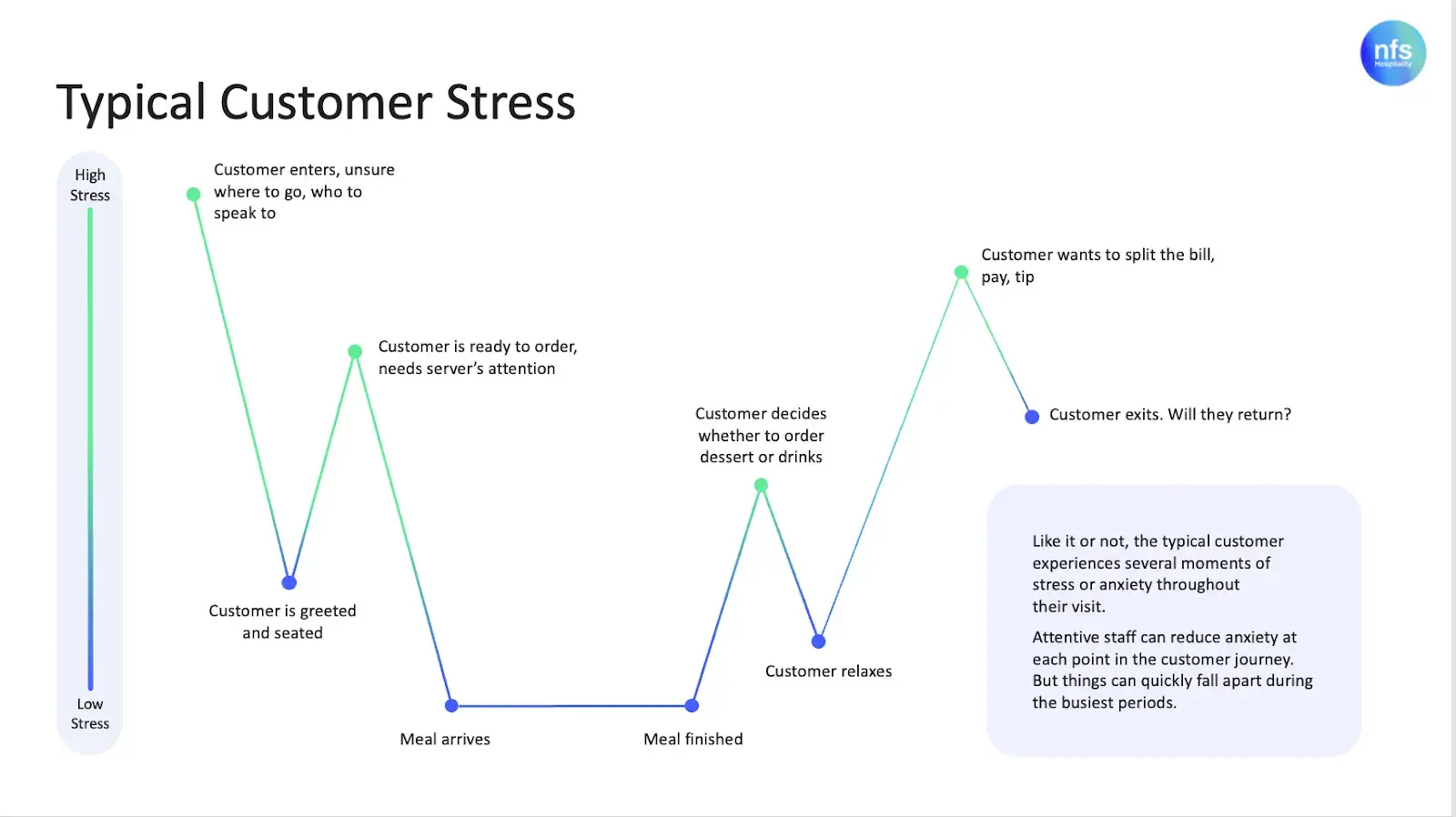
You walk into a restaurant on a busy Saturday night. You’re hungry, tired, and looking for a relaxed experience. But as you step inside, you’re not sure where to go or who you should speak to. That little moment of uncertainty sparks an immediate rise in stress, a feeling you recognise instantly, even if you rarely acknowledge it.
You’re shown to your table and the tension eases. When you’re ready to order and no one’s nearby, it creeps back in. Your food arrives and you relax, until you fancy another drink or dessert and the wait starts again. Then comes the bill – the stress of splitting it, tipping, and waiting for the card machine. That final spike hits just as you hoped the night would end smoothly. Only when you step outside does the pressure lift. These hidden stress points shape how you feel about the entire experience, often more than the food itself. These moments feel emotional to guests, but they’re operational at their core.
“The guest experience begins long before the food arrives.”
Why Stress Points Happen
Guests feel stress when the operation behind the scenes is under pressure. Slow ordering, missing items, overwhelmed staff, and clunky payment processes all stem from one issue – disconnected systems. These moments aren’t about the food. They’re about the systems supporting the team. When technology isn’t connected, everything slows down, and guests feel the impact immediately. This isn’t just a technology problem – it’s a sign that the wider hospitality ecosystem isn’t working in harmony.
“A smooth service creates a calmer, more enjoyable experience once guests walk through the door.”
Joining Up the Journey
Whether guests walk in or book ahead, their emotional journey starts early. When EPOS is connected to a smart booking system, the team knows who’s arriving, any dietary needs, and special occasions before the guest even sits down. It’s not extra tech; it’s a joined‑up journey that reduces stress and helps guests feel recognised and respected. This is what a true hospitality ecosystem looks like – booking, EPOS, payments, and operations all connected, all sharing information, and all working together instead of in silos.
“A booking is not just a transaction. It is the first chapter of the guest experience and journey.”
How EPOS Smooths the Journey
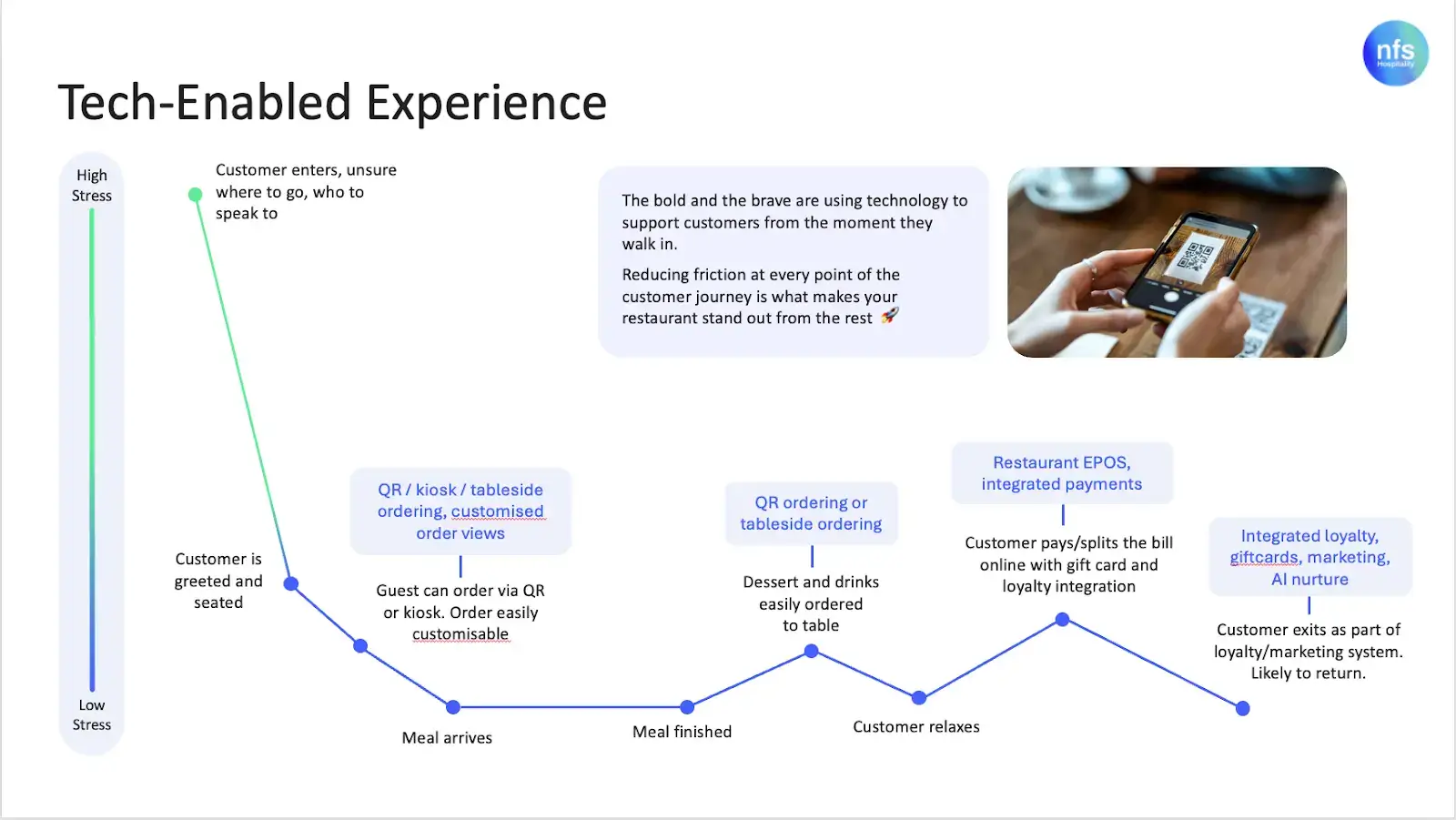
That first click on the EPOS is where the guest experience truly begins, and everything until the first bite is shaped by how smoothly that technology works.
A Confident Start
EPOS gives staff instant visibility of table status, so guests can be greeted and seated quickly, removing the first stress spike.
Ordering Without Uncertainty
Guests can order at the table, via app, or by scanning a QR code – and traditional ordering still fits seamlessly into the same ecosystem. However guests choose to order, there’s no waiting, and no wondering if the order was captured correctly.
A Kitchen That Flows
Orders go straight to the kitchen with no lost notes, no misread handwriting, no bottlenecks. Food arrives on time, and stress levels drop.
Drinks and Desserts Without Delay
Guests can browse menus and reorder without waiting for a server, or choose traditional service – either way, the mid-meal stress spike disappears.
Payment Without Pressure
QR code payments, split bills, gift cards, and loyalty points are all handled digitally – but traditional payments still fit seamlessly into the Hospitality ecosystem. No waiting, no awkwardness, no stress.
When the pressure eases for guests, it eases for staff too. A connected EPOS removes the frantic back‑and‑forth, the guesswork, and the bottlenecks that drain energy during service. Teams feel more in control, more supported, and more able to focus on hospitality rather than firefighting. And when staff morale rises, the atmosphere of the venue rises with it.
“The last impression is as important as the first; a seamless goodbye keeps guests coming back.”
The Experience Guests Remember
When EPOS works quietly in the background, guests feel:
calm
confident
in control
respected
And that emotional ease leads to better reviews, higher spend, and more return visits.
Why NFS Hospitality? Because it’s never just about providing EPOS, it’s about partnership
Every venue has its own challenges and pressure points. That’s why NFS works closely with operators to understand what really happens on the floor – the bottlenecks, the stress moments, the guest expectations.
Rather than delivering a one-size-fits-all system, NFS focuses on building the right setup with operators, creating an environment that supports teams, fits existing workflows, and strengthens the guest journey from first click to first bite.
At the heart of this approach is a connected hospitality EPoS ecosystem – one designed to support smoother operations, reduce stress points, empower staff, and create consistency across sites. When the ecosystem works, the business works, and guests feel the difference.
This isn’t a transaction. It’s a partnership built around understanding how hospitality really operates and shaping the technology around it.
Over the years, the hospitality industry has seen an increase in technological innovations that make day-to-day operations much easier and more efficient. QR code ordering has become the ‘new normal’ for many restaurants, and it’s reshaping customer interactions and operational efficiency. What started as a trend driven by the need for contactless dining in 2020 has now become a standard feature, and one that customers often take advantage of.
As customer needs and expectations evolve, more and more restaurants are embracing the convenience of self-ordering via QR codes and providing customers with the ability to place orders directly from their smartphones without having to speak to a member of staff. In this post, we have explored how QR ordering systems are changing the way restaurants operate and why they have become the new normal across the industry.
The Popularity of QR Code Ordering
QR code ordering is revolutionising the dining experience. By simply scanning a QR code on their table, customers can access digital menus, place their orders and even pay their bill, all directly from their mobile device. This way of ordering prevents the need for traditional paper menus or front-of-house staff taking orders, speeding up the entire process and providing a more enjoyable experience for some diners.
In recent years, QR codes have become increasingly popular due to their convenience and ease of use. They are used across a range of industries in various settings, and as long as customers have a smartphone, they can make the most of self-ordering. With the growing demand for contactless and quick-service options, QR code ordering has quickly become a game-changer for restaurant businesses.
Empowering Customers
One of the main reasons why QR code ordering has become so popular is that it provides customers with more control over their dining experience. They can browse the menu without feeling rushed, exploring various offers and discounts available. Customers can also customise their orders, adding any special requests, and review their choices before submitting them straight to the kitchen. Once they’ve finished eating, they can also pay for their bill via multiple payment methods and without any delays, allowing them to get on with their day.
Since customers are no longer dependent on a server, they can enjoy their dining experience at their own pace. They can immediately place their orders as soon as they’re ready, reducing wait times and preventing delays that often occur when they’re trying to get someone’s attention. This streamlined process is particularly beneficial for quick-service restaurants with a high turnover of tables, making the entire experience more enjoyable.
Minimising Errors
When customers have the option to place their orders themselves, there’s less room for error. Traditional methods, where front-of-house staff write down orders and input them at service kiosks, are often prone to mistakes. From misheard requests to forgotten items, customers can be left dissatisfied and send orders back to the kitchen.
With QR code ordering, customers will directly input their choices into the ordering system. They can double-check the details before proceeding, which reduces the chance of errors. Not to mention, online orders are sent straight to the kitchen display system, reducing the likelihood of miscommunication between teams. This higher level of accuracy, combined with the faster service, will result in a better customer experience and fewer complaints.
Improving Operational Efficiency
In addition to benefiting customers, QR code orders can be incredibly useful for restaurants and will help improve operational efficiency. By reducing the need for employees to take orders manually, they will have more time to focus on other tasks, like serving drinks and meals, and maintaining a clean and welcoming environment.
Self-ordering will also speed up the overall dining process, helping with table turnover and increasing revenue. Since customers can order and pay without waiting for a server, you can seat more guests during busy periods and make the most of seasonal or promotional menus. This low-contact, streamlined process allows for a much more efficient workflow, so you can serve more customers in less time without impacting the guest experience.
Integrating with Restaurant POS Systems
When integrated with a restaurant POS system and kitchen management system, QR code ordering becomes even more effective. Together, these modern systems will enable accurate inventory control and immediate ordering processing. You can provide an uninterrupted service and even update menus in real time if required.
A modern POS system for restaurants also allows you to collect valuable data from QR code orders. From customer preferences and most popular menu items to overall sales trends, you can gain useful insights with advanced reporting capabilities. The data collected can then be used to improve everything from inventory management to staff scheduling, or even make adjustments to menus to meet customer demand more effectively.
Why QR Code Ordering is Here to Stay
As customers’ wants, needs and expectations continue to evolve, QR code ordering is proving to be a lasting trend in the hospitality industry. It perfectly meets the growing demand for fast, efficient and contactless dining experiences, putting the customer in full control. With the benefits for both guests and restaurant staff, it’s no surprise that so many businesses are offering self-ordering solutions to customers.
As QR codes become more of a common sight in restaurants, self-ordering will likely be the standard expectation. Guests enjoy the speed and convenience that comes with ordering and paying directly from their smartphones, and many don’t miss the interaction with servers. For restaurant owners, investing in a QR code ordering system that integrates with a restaurant POS system is a smart move that both improves customer satisfaction and optimises operations, supporting long-term success.
Looking to Implement QR Code Ordering?
It’s fair to say that QR code ordering is reshaping the way restaurants operate and interact with guests. If you’re looking to incorporate QR code ordering into your operations, NFS Hospitality can provide you with a comprehensive system that is trusted by many leading brands in the hospitality industry. Get in touch with our team today to learn more about how QR code ordering can benefit your business.
An Electronic Point of Sale (EPOS) system can optimise restaurant operations. This comprehensive software will manage all key aspects of your restaurant business, from order-taking to inventory control, providing you with one central system that can improve overall efficiency. However, it’s important to ensure you’re choosing the right EPOS software for your specific needs to truly reap the benefits of this powerful tool.
When narrowing down the available options, it’s important to consider more than just the features available. It’s essential to find an EPOS system that suits your operations, budget and long-term goals. Regardless of what type of restaurant you operate, you should evaluate your business needs and ensure the software is suitable for the day-to-day running of your business. Below, we have explored the key factors that will influence which EPOS system will work best for your restaurant and how you can make the most informed decision.
Size and Type of Venue
The type of restaurant you operate and the scale of your operations will play a crucial role in determining which EPOS system is best. For instance, smaller independent restaurants often have simpler workflows and fewer members of staff. Therefore, a user-friendly system that covers all the essentials, such as order-taking, payment processing and simple reporting, might be sufficient. Budget may also be a key consideration for smaller businesses.
On the other hand, larger restaurants or franchises typically need a more powerful system. Multi-location restaurants can benefit from cloud-based EPOS systems that provide centralised control over all sites and make it easy to manage operations from anywhere. Whether it’s updating menus or monitoring sales performance, having the ability to do so from a single dashboard offers several benefits and can streamline operations.
Menu Complexity and Workflow Requirements
Whether you have a simple menu that doesn’t change much throughout the year or a complex menu with multiple promotions and seasonal offerings will also impact which EPOS software is best suited to your needs. If your menu includes various customisation options and multiple courses, an EPOS system that sends orders directly to kitchen display systems can be beneficial, reducing the likelihood of mistakes and speeding up service.
Review your entire current workflow, from order-taking to payment processing, and consider the current communication between front-of-house and kitchen staff. The best EPOS software for restaurants should solve any pain points, such as offering tableside ordering to reduce wait times and optimise table turnover, or tracking inventory in real-time to update menus and prevent customer disappointment.
Integration with Other Systems
A restaurant EPOS system should do more than just process transactions; it should integrate with the other tools you rely on. When your EPOS software speaks to key systems, such as your reservation platforms, loyalty programmes and omni-channel ordering solutions, you can benefit from a seamless flow of information.
Look at which systems you use at different stages of the customer journey and consider how integration can streamline operations. When your software is in sync, it will improve accuracy and efficiency, and prevent issues with data loss.
Budget and Pricing Structure
Your budget is always an important factor when investing in new software. When it comes to a restaurant EPOS system, you need to consider the total cost of ownership, not just the upfront price. In addition to initial setup costs, covering hardware and installation, there are often ongoing subscription fees to be aware of.
Factors such as number of users and locations, amount of cloud data storage, customer support and updates, and also additional features will all impact the monthly costs associated with an EPOS system. When comparing costs, it’s important to factor the long-term return on investment into your decision too. While one EPOS system may cost more, if it offers significant benefits that can boost revenue, it could be more cost-effective over time.
Scalability and Future-Proofing
It’s wise to think ahead when you’re investing in new software. Choosing an EPOS system that can grow with your business can save you a lot of hassle in the long run. You can avoid having to switch platforms and re-train staff if your small business expands into new locations.
A future-proof EPOS solution should allow you to add more locations, terminals or users easily, supporting business growth. It should also support updates and new technologies, ensuring your restaurant remains compliant with industry standards and continues to meet customer expectations. With improved business intelligence, EPOS software can even help you grow your restaurant quicker. By using reporting tools, you can make data-driven decisions and reach your goals much sooner.
Technical Support and User Experience
Your software should always be straightforward to use, for both customer-facing and back-of-house teams. A confusing interface can slow down service and result in mistakes that negatively affect customer experience, especially during busy periods. Training should be simple too, making it easy to take on new staff and hit the ground running.
For restaurant EPOS systems, responsive customer support is essential. Whether you need help setting up hardware, adding new features or troubleshooting an issue, a provider with reliable technical support can make a huge difference. You can have peace of mind that your EPOS software is robust and reliable, and you will have an uninterrupted service.
Choosing the Best EPOS Software for Your Restaurant
Choosing an EPOS system is a key decision and one that will have a direct impact on your operations moving forward. At NFS Hospitality, we understand that no two restaurants are the same, and we deliver the best of breed software. Our EPOS solutions are designed to adapt to a wide range of operational needs, and they provide you with one smart, centralised system.
Our expert team will work closely with you to evaluate your current setup, identify your pain points, and recommend tailored solutions that suit your goals and budget. We have experience working with the biggest brands in hospitality and invite you to read some of the case studies on our website. If you have any questions about EPOS software for restaurants, feel free to get in touch with NFS Hospitality today.
No matter how a customer chooses to engage with your brand, there’s no doubt that they’ll expect a smooth and convenient experience. Whether they choose to reserve a table online, dine in at your restaurant or even place an order via an app, maintaining a clear brand consistency and experience across all touchpoints is now a baseline expectation.
As the hospitality sector continues to become increasingly digital, delivering a unified and frictionless journey is key to building loyalty and staying competitive. A fully integrated omnichannel ordering system is a powerful starting point. When aligned with your existing restaurant management software, it lays the groundwork for streamlining operations and improving customer experience.
At NFS Hospitality, we believe that top restaurant management software should allow operators to deliver a consistent and high-quality experience across every channel. In this article, we’ll explore how an omnichannel approach can help you achieve exactly that.
Why Consistency Matters in Hospitality
Inconsistent service can lead to confusion, customer dissatisfaction, and even lost revenue. On the other hand, delivering a consistent experience helps build trust in your brand. When customers receive the same high level of quality and service, whether online, in-app, or in your venue, it reinforces confidence and strengthens loyalty.
Consider the typical customer journey in today’s world: A customer may browse your menu online, place an order for delivery via a third-party app, and later visit in person. Each of these interactions contributes to their overall perception of your brand. If the information, pricing, or service quality differs from one touchpoint to another, it creates a disjointed experience. This is where omnichannel strategy – backed by intelligent systems – comes into play.
What is an Omnichannel Ordering Experience?
Omnichannel ordering allows customers to interact with your restaurant across multiple channels in a connected and consistent way. Whether they’re ordering from a kiosk, app, website, or at the table, the experience should feel seamless and unified.
This differs from a multichannel setup, where services exist on multiple platforms but operate independently. Omnichannel systems integrate those channels, allowing data, preferences, and communication to flow across the entire customer journey.
An effective omnichannel approach means:
Menus and prices are consistent across all platforms.
Loyalty points or offers apply regardless of ordering method.
Customer data is centralised for more personalised interactions.
Staff have visibility into every transaction, regardless of origin.
The Role of Restaurant Management Software
Delivering a consistent omnichannel experience depends heavily on the technology behind the scenes. Restaurant management software platforms play a central role in integrating these channels.
At NFS Hospitality, our innovative restaurant management solutions have been designed with this in mind. Our restaurant EPOS systems enable operators to manage menus, pricing, promotions, and ordering across multiple platforms – all from a single, centralised system. This ensures consistency from back-of-house to front-of-house and beyond.
For example:
Menu management: Update your menu just once and reflect changes across all channels simultaneously to ensure accuracy.
Order management: Whether orders come from online, third-party platforms, or in-house tablets, they flow into the same kitchen display and reporting system, reducing errors and improving speed of service.
Loyalty integration: Track customer preferences and rewards in real time, whether guests are dining in, ordering takeaway, or booking a future visit.
The Benefits of Integrated Omnichannel Tools
When your restaurant management software supports integrated omnichannel ordering, the benefits go far beyond operational efficiency – it enables a smooth and connected experience across every customer interaction.
Customers can enjoy effortless ordering, whether through a mobile app, website, or in-venue kiosk, with consistent menus, clear pricing and reliable functionality throughout. Accuracy also improves thanks to the automation of orders routed to the kitchen, reducing the risk of mistakes in the process.
A centralised view of customer behaviour allows for smarter personalisation, enabling teams to tailor promotions and upselling strategies more effectively. Most importantly, consistent service across all channels builds trust and strengthens brand loyalty, encouraging repeat visits and positive word of mouth.
Operational Advantages for Hospitality Teams
In addition to customer-facing benefits, integrated omnichannel systems offer several operational advantages:
Real-time reporting: Gain accurate insights into sales, performance and demand across all channels in one dashboard.
Inventory management: Automatically track stock usage across dine-in, delivery, and takeaway to reduce waste and manage stock more efficiently.
Workforce optimisation: Align staffing levels with real-time order volume across all channels.
By implementing top restaurant management software, hospitality operators can adapt quickly to changing demand and manage operations in a more centralised and strategic manner.
Ready to Streamline your Omnichannel Experience?
Ensuring the success of your restaurant both today and in the future requires agility as customer expectations and technologies evolve at pace. Thankfully, with integrated restaurant management software, you can scale services, launch new ordering channels, and explore innovations like self-service, without any compromise on consistency or control.
At NFS Hospitality, we help hospitality operators build scalable digital ecosystems that deliver exceptional and connected customer experiences. Ready to streamline your omnichannel journey? Get in touch with our team today to discover how our solutions can help your business grow and thrive in a digital-first world.
Cafés in the UK are more than places to grab a coffee—they’re vibrant community hubs that marry culinary artistry with social connection. Yet behind every perfectly pulled espresso and freshly baked croissant lies a web of operational challenges, from managing café inventory to ensuring swift order fulfilment during peak hours. Rising overheads, shifting customer expectations for mobile and touchless service, and the need for data-driven insights make manual processes increasingly untenable. This is where café management software—also known as EPOS systems for cafés or hospitality management software—steps in as a game-changer.
A modern POS system for cafés unifies point-of-sale transactions, kitchen workflows, stock control, and marketing automation within a single, cloud-based platform. Whether you operate a cosy independent coffee shop in Edinburgh or a multi-location café concept in Manchester, the right cloud-based café software ensures accuracy, speeds up service, and delivers real-time analytics that drives profitability. From café inventory management and order management to customer relationship management (CRM) for restaurants, these solutions empower you to make informed decisions and focus on what matters most—delighting your customers.
What is a POS in a Café?
A Point of Sale (POS) in a café is the nexus of every transaction and a hub for operational data. Beyond simple cash handling, a modern café POS:
Integrates multiple payment types: keep contactless cards, mobile wallets (Apple Pay, Google Pay), gift vouchers, and loyalty points in one seamless interface. Ensure speed and security at peak times.
Centralises order entry and routing: orders taken at the counter, tableside, or via mobile apps flow automatically to the correct printer or Kitchen Display System (KDS), eliminating manual ticket sorting.
Records granular sales data: drink modifiers (e.g., oat or almond milk), special requests, and transaction timestamps feed into reports that inform staffing rotas and menu tweaks.
Supports compliance: built‑in VAT categorisation, digital receipts, and audit logs make it straightforward to meet HMRC requirements and support financial audits.
In the UK’s café market—where independents and small chains juggle high footfall and tight margins—this convergence of front‑of‑house and back‑of‑house functionality is essential for consistent, high‑quality guest experiences.
How to Choose the Best Café POS System
Selecting the ideal POS isn’t one‑size‑fits‑all. Here’s how to match software capabilities to your café’s ambitions:
Identify Core Needs:
Do you require tableside ordering with handheld tablets? Or will fixed touchscreen terminals suffice?
Is integration with online ordering platforms and delivery partners (e.g., Deliveroo, Just Eat) critical for your business?
Evaluate Software Features:
Order Management: real‑time ticket-splitting, course timing, and kitchen prioritisation.
Inventory Control: auto‑depletion of ingredients, reorder alerts, and recipe costings by SKU.
CRM & Loyalty: customer profiling by spending and visit frequency, plus tiered rewards and automated re‑marketing campaigns.
On-premise solutions can work entirely offline, which is valuable if your location has unreliable connectivity.
Scalability and Multi‑Location Support:
Look for Unified Reporting across outlets, centralised product updates, and consolidated financial dashboards.
Total Cost of Ownership:
Map out one‑off hardware costs, subscription tiers, transaction fees, and support plans. Factor UK‑specific VAT implications on recurring charges. Platforms such as the SkyTab POS for Cafes are appealing due to the £0 upfront cost.
Vendor Ecosystem and Integration:
Ensure compatibility with accounting platforms like Xero or Sage, and ancillary services such as payroll, e-commerce, and accounting.
Local Support and Training:
UK‑based customer service and on‑site installation options can greatly reduce implementation headaches.
A methodical needs analysis, followed by hands‑on demos and peer reviews, ensures you invest in a system that drives growth rather than frustration.
Cloud‑Based Café POS
Cloud POS solutions have revolutionised how UK cafés operate:
Real‑Time Menu and Pricing Updates: Change a latte price or introduce a seasonal special across all terminals instantly, with no manual reprogramming.
Mobile Back‑Office Access: Owners and managers can review live sales, staff performance, and stock alerts from any browser or smartphone, 24/7.
Zero Maintenance Overhead: Software patches, security updates, and new features deploy automatically, reducing IT dependencies.
Enhanced Security and Backups: Data is encrypted and stored in geographically redundant UK data centers, safeguarding against hardware failures.
Flexible Licensing: Scale up with pay‑as‑you‑grow plans—ideal for burgeoning chains or pop‑up concepts.
Where seasonal menus and promotional windows are vital, cloud‑based flexibility becomes a strategic advantage.
User‑Friendly Interface: Quick Ordering
In the rush of a morning coffee run or lunch break, speed and accuracy matter:
Customisable Button Layouts: Group best selling items and modifiers together to reduce taps and eye movement.
Intuitive Search and Item Lookup: Fuzzy search allows baristas to type partial names (e.g., “latte choc”) and instantly locate the correct item.
One‑Touch Order Customisation: Quickly add extras or alter ingredients without navigating deep menus.
Table Management Tools: On‑screen floor plans let staff track open tabs, assign orders to tables, and process payments seamlessly.
Offline Transactions and Sync: Continue selling even if connectivity drops—transactions sync automatically once online.
Training time drops significantly—key in an industry with seasonal hiring—while error rates plummet, boosting customer satisfaction.
Branded Ordering Apps or White‑Label Web Portals: Present your café’s branding, menu, and imagery for a cohesive experience.
Automated Fulfilment Workflows: Orders placed remotely auto‑populate in the POS and KDS, tagged by pick-up time.
Dynamic Pick‑Up Windows: Offer time slots based on real‑time kitchen capacity, smoothing demand peaks.
API Integrations: Sync with third‑party platforms (Uber Eats, Just Eat) to centralise all orders in one dashboard.
Order Status Notifications: Push SMS or in‑app alerts when the customer’s drink is ready, reducing crowding at the counter.
This omnichannel approach boosts revenue by tapping into customers’ desire for quick, contactless transactions.
Customer Insights with Café Analytics
Data without action is wasted. Advanced analytics modules empower you to:
Track Key Performance Indicators (KPIs): Average transaction value, items per sale, peak hour performance, and staff efficiency.
Segment Customer Behaviour: Identify high‑value regulars versus occasional visitors and tailor loyalty rewards accordingly.
Menu Engineering: Conduct basket analysis to discover complementary items (e.g., biscotti with cappuccino) and design promotions.
Lapsed Customer Campaigns: Automatically trigger re‑engagement offers if a patron hasn’t visited in a set timeframe.
ROI Measurement: Attribute sales lift to specific marketing campaigns- email blasts, SMS promos, or social media ads.
By turning data into targeted strategies, UK café owners can drive repeat business and optimise menu profitability.
Café Inventory Management
Tight control over ingredients separates profitable cafés from break‑even operations:
Real‑Time Stock Tracking: Automatic deduction of raw materials (coffee beans, milk, syrups) with every sale.
Waste Monitoring: Log waste events (spills, over‑production) against stock levels to identify efficiency gaps.
Vendor Management and Auto‑Reordering: Link supplier pricing and lead times to your system purchase orders when the stock dips below the threshold.
Batch and Expiry Tracking: Ensure freshness and compliance with food safety standards by monitoring use‑by dates.
Cost Analysis and Budget Forecasting: Compare actual consumption to forecasts and adjust par levels to reduce spoilage.
For UK cafés operating on thin margins—often as low as 2–5%—cafe inventory management capabilities are not optional; they’re mission‑critical.
Kitchen Management Software: Cleaning It Up
Bridging front‑of‑house enthusiasm with back‑of‑house efficiency, kitchen management modules offer:
Kitchen Display Systems (KDS): Colour‑coded tickets by order age or course type, ensuring hot and cold items hit the pass simultaneously.
Workflow Optimisation: Customisable prep stations that allocate tasks (drinks bar, food counter) based on staff roles.
Order Status Tracking and Alerts: Visual cues and audio notifications signal when tickets are high‑priority or delayed.
Performance Dashboards: Monitor average prep times per item and identify bottlenecks in real-time.
Integration with Order Management: Seamlessly adjust cooking sequences when a customer adds or cancels items.
Reducing order turnaround by 30 seconds per sale during UK lunch and breakfast peaks can translate to hundreds of extra covers per week.
Café Marketing Campaigns: Automated Marketing
Building lasting relationships hinges on timely, relevant communication and tailored marketing campaigns:
Segmented Campaigns: Use purchase history to group customers by preferences—e.g., vegan options or biscotti lovers—and send targeted promotions.
Automated Triggers: Birthday vouchers, anniversary discounts, and win‑back offers when a patron hasn’t visited in 30 days.
Multi‑Channel Delivery: Combine email, SMS, and in‑app notifications to meet customers where they engage most.
Loyalty Programme Management: Digital stamp cards or points systems integrated directly into the POS, no plastic cards to lose.
A/B Testing and Performance Tracking: Experiment with offer types and measure open rates, redemption, and incremental revenue.
Automating these workflows saves staff hours each week and keeps your café top‑of‑mind in a crowded UK marketplace.
Making the Final Decision: Best Cafe Management Software
Choosing the right café management software is a strategic investment that will shape your day‑to‑day operations, customer satisfaction, and bottom line. Here’s a roadmap to guide your final decision:
Map Your Priorities
List the non‑negotiables: inventory automation, robust café analytics, integrated CRM, or mobile ordering.
Highlight “nice‑to‑haves” such as advanced marketing automation or multi‑location reporting.
Compare Feature Sets Against Real‑World Needs
Run scenario tests during demos: process a rush‑hour order, create a click & collect transaction, or trigger a loyalty campaign.
Ensure each module, be it kitchen management software, cloud POS, or order management, works seamlessly in a UK café environment.
Evaluate Total Cost of Ownership (TCO)
Calculate up‑front hardware investment for touchscreen POS terminals and handheld devices.
Factor in monthly or annual subscription fees (inclusive of UK‑specific VAT) and per‑transaction charges.
Build in support, training, and potential upgrade expenses over a 3‑ to 5‑year horizon.
Prioritise Vendor Support and UK Market Expertise
Look for providers with dedicated UK-based customer service, on‑site installation options, and familiarity with HMRC compliance.
Check peer reviews from British café owners to validate responsiveness and reliability.
Test, Iterate, and Engage Staff
Conduct a pilot in one location or during off‑peak hours to gather feedback on the user-friendly interface, tableside ordering, and reporting tools.
Involve your baristas and managers in testing—staff buy‑in is crucial for a smooth rollout.
Leverage Free Trials and Demos
Don’t hesitate to request extended trials or sandbox environments.
Use trial data to evaluate café inventory management, customer insights, and how easily you can customise menus or promotions.
Conclusion
Adopting a comprehensive café management software solution in the UK is no longer optional—it’s essential. From real‑time cloud POS access and streamlined café inventory management to powerful analytics, kitchen management, and marketing automation, the right EPOS system can transform your café into a lean, data‑driven operation. As consumer habits evolve—expecting fast, personalised service whether they’re dining in, ordering takeaway, or clicking & collecting—investing in the best POS system for cafés is your ticket to happier customers, efficient teams, and healthier margins.