Running a successful restaurant in today’s competitive landscape requires more than just delicious food and excellent service. It demands efficiency, data-driven decisions, and the ability to adapt and evolve to customer expectations. A modern EPOS system for restaurants is no longer a luxury, but a necessity for optimising operations and driving profitability. This guide will explore how the best POS system for a restaurant can revolutionise your business.
What is an EPOS System for a Restaurant?
An Electronic Point of Sale (EPOS) system is a comprehensive software and hardware solution designed to manage sales, orders, and transactions in a restaurant setting. A robust EPOS system acts as the central nervous system of your restaurant, integrating everything from order-taking and table management to inventory control and customer relationship management.
Key Benefits:
Enhanced Order Management: Streamlines order processing from the table to the kitchen.
Improved Customer Experience: Enables faster service with features like Tableside Ordering and Payment Systems.
Accurate Sales Reporting: Offers detailed insights that help refine business strategies.
Integrated Payment Solutions: Simplifies transactions for both customers and staff.
Understanding how to use an EPoS system in restaurants is crucial for leveraging its full potential. The right system can reduce errors, boost efficiency, and support customer retention management—all critical components for long-term success.
Core Restaurant POS System Features
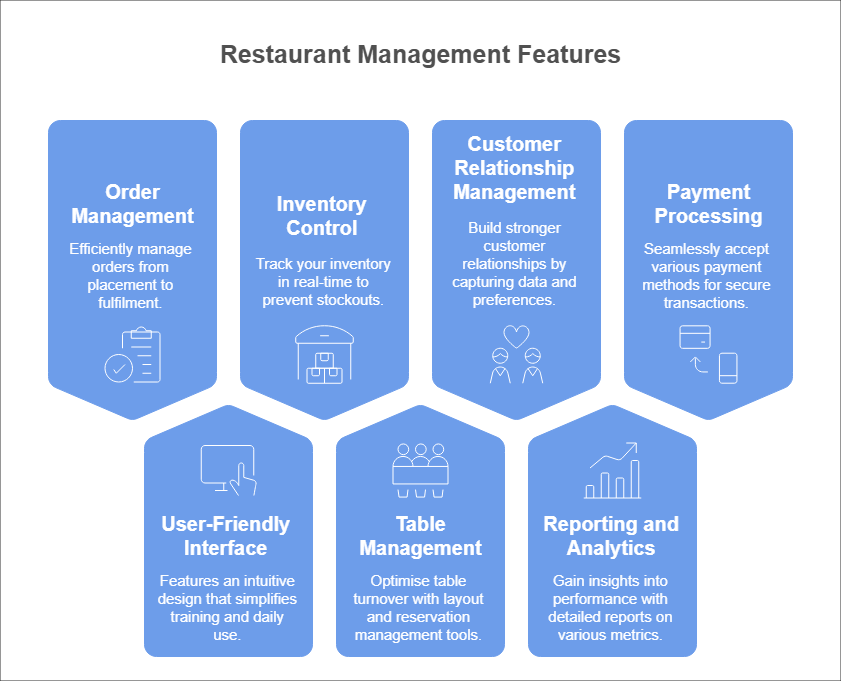
A truly effective restaurant POS system offers a range of features designed to enhance every aspect of your business. These core functionalities include:
Order Management: Efficiently manage orders from placement to fulfilment, minimising errors and speeding up service. This includes features like order modification, splitting bills, and managing special requests.
User-Friendly Interface: Features an intuitive design that simplifies training and daily use, paired with touchscreen functionality to boost speed and accuracy during high-volume periods.
Inventory Control:Track your inventory in real-time, preventing stockouts and reducing waste. Receive alerts when items are running low and automate purchase orders.
Table Management: Optimise table turnover with intuitive layout and reservation management tools. Visualise your dining room, track table status, and efficiently seat guests.
Customer Relationship Management (CRM): Build stronger customer relationships by capturing customer data, tracking preferences, and creating targeted promotions. Understand your customer base and personalise their dining experience.
Reporting and Analytics: Gain valuable insights into your restaurant’s performance with detailed reports on sales, inventory, labour costs, and more. Make informed decisions based on real-time data.
Payment Processing: Seamlessly accept various payment methods, including credit cards, debit cards, and mobile payments. Ensure secure and efficient transactions.
How to Use a POS System in Restaurants: An Expanded Step-by-Step Guide
Implementing an EPOS (Electronic Point of Sale) system may seem intimidating, but with a structured approach, you can smoothly transition to a system that enhances efficiency and customer experience. Here’s an in-depth look at each step in the process:
Step 1: Assessment of Needs
Evaluate Your Current Operations: Begin by mapping out your existing workflow. Look at every stage—from order taking and processing to payment and inventory management. Consider where delays occur or errors are frequent.
Identify Pain Points: Take note of issues such as slow order processing, payment delays, or miscommunications between the front-of-house and the kitchen. This insight helps you understand what you need most from a new system.
Example:
If you find that your servers struggle with outdated order-taking methods, a system with a modern, intuitive interface could significantly reduce mistakes and speed up service.
Step 2: Research and Selection
Search for Cloud-Based EPOS Systems: Investigate systems that offer cloud-based solutions. A cloud-based EPOS system allows remote access, easier updates, and integration with other digital tools.
Compare Features: Look at key functionalities such as order management, inventory tracking, payment processing, and reporting. Consider whether the system can scale as your business grows.
Evaluate Customer Support: Ensure the provider offers robust support. This is crucial during implementation and for troubleshooting any future issues.
Tip:
Create a checklist of your must-have features and use it to compare different systems. Read reviews and perhaps request demos to see how the system performs in a real-world scenario.
Step 3: Staff Training
Invest in Comprehensive Training: Arrange detailed training sessions for all staff members. This includes navigating the user-friendly interface and understanding the core functionalities, from taking orders to processing transactions.
Tailor Training to Roles: Customise sessions so that servers, kitchen staff, and managers know the aspects of the system relevant to their work. For instance, kitchen staff should focus on how orders are received and updated in real time.
Note:
Well-trained staff not only reduce errors but also help in smoothing the transition, as they can confidently assist each other during the initial phase.
Step 4: System Integration
Integrate with Existing Tools: Connect your new EPOS system with current kitchen management software, reservation platforms, and CRM tools. Integration is key to creating a seamless flow of information across your operations.
Ensure Seamless Connectivity: Verify that the connection between the EPOS system and front-of-house tools is smooth. This will ensure that when an order is taken, it is instantly communicated to the kitchen, and any updates are reflected in real time.
Consideration:
Test the integration on a small scale before rolling it out restaurant-wide to ensure that all systems communicate properly without data loss or delays.
Step 5: Trial Phase
Conduct a Pilot Run: Run the new system during off-peak hours to minimise risk. This trial phase is your chance to see the system in action without the pressure of a busy service.
Collect Feedback: Engage with your staff to understand their experiences using the system. Look for any difficulties they encounter or features that need tweaking.
Make Adjustments: Use the feedback to refine system settings, update training materials, or adjust integration points. This step ensures that issues are ironed out before full-scale implementation.
Reminder:
Document the feedback and the adjustments made. This record will be invaluable for future training sessions and system updates.
Step 6: Full Implementation
Plan a Strategic Rollout: Choose a go-live date that minimises disruption—ideally during lower customer traffic. Announce the change internally so everyone is prepared for the transition.
Monitor Performance: Once the system is live, closely observe its performance with key metrics such as order processing times, payment accuracy, and overall staff feedback.
Continue Staff Training: Offer refresher courses or additional training as needed. Continuous support helps ensure employees remain confident and proficient with the system.
Final Thought:
Successful implementation is an ongoing process. Regularly review system performance and stay updated with any new features or improvements offered by the provider.
Cloud-Based POS System
One of the most transformative advances in restaurant technology is the rise of cloud-based EPoS systems and PoS cloud solutions. These systems offer a range of benefits that are particularly attractive to modern restaurants:
Accessibility: Access your system from anywhere with an internet connection. Manage your restaurant remotely and monitor performance in real time.
Scalability: Easily scale your system as your business grows. Add new terminals and features without significant hardware investments.
Cost-Effectiveness: Reduce upfront costs with cloud-based subscriptions. Minimise IT expenses and maintenance fees.
Automatic Updates: Benefit from automatic software updates, ensuring you always have the latest features and security patches.
With cloud-based solutions, restaurant owners and managers can gain access to real-time analytics and insights, helping optimise operations and improve customer retention management.
Kitchen Management Solutions
Efficient kitchen operations are critical to the success of any restaurant. Integrated epos kitchen solutions are designed to streamline the communication between the front-of-house and the kitchen, ensuring that orders are processed accurately and quickly.
Display Orders: Display orders clearly on screens in the kitchen, eliminating paper tickets and improving communication between front-of-house and back-of-house staff.
Track Order Progress: Monitor the status of each order, ensuring timely preparation and delivery.
Manage Recipes: Access recipe information directly from the kitchen display system, ensuring consistency in food preparation.
Integrate your EPOS system with kitchen management tools, ensuring every order is prepared accurately and delivered. Thereby enhancing overall operational efficiency and customer satisfaction.
How to Set Up Your POS System: Your Easy Guide
Setting up your POS system can seem daunting, but it doesn’t have to be. Here’s a simplified guide:
1. Choose the Right System
Evaluate Requirements: Identify your business needs (features, scalability, budget) and industry-specific requirements.
Research Options: Compare vendors, read customer reviews, and check for reliable support and integration capabilities.
2. Hardware Installation
Gather & Install: Acquire necessary devices like POS terminals, printers, and barcode scanners, and arrange them according to your layout.
Connect & Test: Set up device connections (wired or wireless) and perform initial tests to ensure all hardware functions properly.
3. Software Setup
Install & Configure: Download and install the POS software, then customise it with your business details such as tax rates and payment methods.
Input Data: Enter inventory details, and pricing, and create user accounts; integrate with other systems as needed.
4. Staff Training
Plan & Execute: Develop a training program tailored to different roles with hands-on sessions and clear instructions.
Provide Resources: Supply user guides, video tutorials, and troubleshooting tips to support ongoing learning and quick problem-solving.
5. Go Live
Soft Launch: Begin with a trial run during off-peak hours to test the system’s performance and gather feedback.
Full Rollout: Officially launch the system after addressing any issues, while maintaining monitoring and support for smooth operation.
Beyond the Basics: Enhancing the Dining Experience
Modern EPOS systems offer a range of features that can further enhance your restaurant operations and customer experience:
Mobile Ordering Devices: Empower your staff with mobile ordering devices, allowing them to take orders and process payments tableside. This improves efficiency and provides a more personalised service.
Online Ordering and Delivery Integration: Integrate your POS system with online ordering platforms and delivery services, expanding your reach and increasing revenue.
QR Code Ordering: Offer customers the convenience of ordering and paying using their smartphones via QR codes.
Customer Retention Management: Utilise CRM features to track customer preferences, personalise offers, and build loyalty.
Investing in the best POS system for your restaurant is an investment in your future. By choosing the right system and utilising its features effectively, you can streamline operations, enhance customer experience, and drive profitability. Embrace the power of technology and watch your restaurant thrive.
Within the competitive hospitality landscape, leveraging technology is no longer optional—it’s a necessity. Restaurant management software has evolved to become the backbone of efficient operations, integrating everything from a robust POS system and kitchen management software to seamless inventory management and customer engagement tools. Choosing the right solution is a strategic decision that can streamline operations, reduce costs, and elevate the customer experience. This comprehensive guide will help you navigate the critical features and emerging trends in restaurant management software, ensuring your business stays ahead of the curve.
Understanding Restaurant Management Software
Restaurant management software is a comprehensive digital tool designed to integrate and streamline various aspects of your restaurant’s operations. It combines multiple functionalities that are critical for managing daily tasks efficiently.
Some of the key components include:
POS (Point of Sale) Systems: The central hub for processing orders, payments, and transactions.
Kitchen Management Software: Tools that help streamline order preparation and kitchen communication.
Inventory Management: Software to track ingredients and supplies, and reduce waste.
Workforce Management Software: Solutions to manage employee schedules, payroll, and performance.
Customer Engagement: Features like QR code ordering and loyalty programmes that enhance the dining experience.
By understanding these elements, restaurant owners can tailor their technology investments to meet specific operational needs, ensuring every aspect of the business runs smoothly.
Key Features to Look For
When selecting restaurant management software, it’s essential to evaluate features that align with your operational requirements. Consider the following critical components:
Integrated POS System
Arobust POS system is the heart of any restaurant management solution. In the realm of cloud-based POS systems, having the most up-to-date features is crucial. It handles order processing and payments while providing valuable sales data.
Key benefits include:
Streamlined Transactions: Quick and efficient processing reduces wait times and improves service.
Real-Time Reporting: Access to sales analytics helps make informed business decisions.
Integration: Seamlessly connects with other systems like inventory and kitchen management software.
Kitchen Management Software
Efficient kitchen management is crucial for timely order preparation and ensuring food quality—Optimise kitchen operations with advanced kitchen display systems. Connect seamlessly with POS systems, reduce paper waste, and automate order flows.
Modern kitchen management software helps:
Improve Communication: Bridge the gap between front-of-house and kitchen staff.
Enhance Order Accuracy: Reduce errors through digital order management.
Optimise Workflow: Prioritise and manage orders during peak hours effectively.
Inventory Management
Perform inventory counts whenever needed, accurately forecast demand, access in-depth analytics, and streamline supplier management through automation. Real-time tracking minimised waste, and precise inventory control all contribute to enhanced profitability and operational efficiency.
Benefits can be like:
Real-Time Tracking: Monitor ingredient usage and prevent shortages.
Cost Control: Identify high-cost items and streamline purchasing processes.
Waste Reduction: Maintain optimal stock levels to minimise food waste.
Workforce Management Software
Managing a restaurant’s staff can be challenging. Get a clear view of your schedule with weekly, fortnightly, and monthly overview options.Workforce management software simplifies scheduling, attendance tracking, and payroll processing, ensuring:
Optimised Schedules: Align staffing levels with peak business hours.
Improved Productivity: Reduce labour costs by efficiently managing employee shifts.
Enhanced Communication: Facilitate timely updates and feedback between management and staff.
QR Code Ordering & Mobile Capabilities
Embracing technology such asQR code ordering is vital in today’s fast-paced hospitality environment. Transform the dining experience by enabling customers to scan codes, view digital menus, place orders, and pay directly from their mobile devices. This approach minimizes the need for server interactions and speeds up service.
This feature allows guests to:
Order Directly from Their Phones: Enhances convenience and minimizes contact.
Reduce Wait Times: Accelerates the ordering process during busy periods.
Improve Accuracy: Digital menus reduce the risk of human error in order taking.
Loyalty Programme Integration
Promote sustainable growth with customized loyalty programs. Deliver individualized promotions and connect with guests across various touchpoints. Leverage data insights to track key metrics and uncover opportunities that drive repeat visits.
Integrating a loyalty programme within your restaurant management software can:
Reward Frequent Customers: Incentivize repeat visits through exclusive offers.
Gather Valuable Data: Understand customer preferences and behaviour.
Boost Revenue: Increase average order values and overall customer satisfaction.
Hospitality Technology Trends
The hospitality industry is rapidly evolving, driven by technological advancements that redefine how restaurants operate. Here are some of the latest trends shaping the industry:
Embracing Cloud-Based Solutions
Scalability:Cloud-based systems grow with your business, ensuring you’re never left behind.
Real-Time Updates: Access the latest features and security enhancements seamlessly.
Cost-Effective: Lower upfront costs compared to traditional on-premise systems.
Contactless and Mobile Ordering
The rise of QR code ordering and mobile apps has transformed the dining experience, providing:
Safety: Contactless transactions reduce health risks.
Convenience: Streamlined processes allow customers to order and pay with ease.
Enhanced Data Collection: Track customer preferences and order history for personalized marketing.
Data-Driven Decision Making
Modern restaurantmanagement software offers robust analytics and reporting features, enabling you to:
Monitor Performance: Real-time dashboards provide insights into sales, inventory, and staff productivity.
Optimize Operations: Data-driven insights help identify areas for improvement.
Forecast Trends: Anticipate demand and adjust inventory and staffing accordingly.
POS System: The Heart of Restaurant Management Software
Areliable POS system is critical for any restaurant looking to enhance operational efficiency. Beyond processing transactions, modern POS systems integrate seamlessly with other management tools to provide a holistic view of your business.
Consider these advantages:
Efficient Order Processing: Speed up service and reduce customer wait times.
Integrated Payment Solutions: Manage restaurant deposits and streamline financial transactions.
Comprehensive Reporting: Access detailed analytics to monitor sales trends, inventory levels, and employee performance.
By choosing a POS system that fits your restaurant’s unique needs, you ensure that every transaction is smooth and secure, contributing to overall operational excellence.
QR Code Ordering: Enhancing Customer Experience
QR code ordering is rapidly becoming a staple in the modern dining experience. This technology offers several benefits that not only improve service speed but also elevate customer satisfaction:
Enhanced Safety: Minimizes physical contact between staff and customers.
Streamlined Process: Allows guests to browse menus, place orders, and pay directly from their smartphones.
Operational Efficiency: Reduces errors associated with manual order taking, leading to faster service.
Increased Convenience: Supports a contactless experience that is particularly appealing in today’s health-conscious environment.
For restaurants seeking to modernize their operations, incorporating QR code ordering can lead to a significant competitive advantage.
Loyalty Programme: Building Repeat Customers
A well-integratedloyalty programme within your restaurant management software can transform occasional visitors into loyal patrons.
Here’s why a loyalty programme is essential:
Customer Retention: Reward frequent customers with points, discounts, or exclusive offers.
Data Collection: Gain insights into customer preferences to tailor promotions and services.
Enhanced Engagement: Foster a deeper connection between your brand and your customers.
Increased Revenue: Encourage repeat visits and higher spending per visit through targeted incentives.
By investing in loyalty programme features, you create a win-win situation where customers feel valued, and your restaurant enjoys sustained growth.
Making the Final Decision
Choosing the best restaurant management software involves careful consideration of your unique business needs. Here are some actionable steps to help you make an informed decision:
Assess Your Requirements:
Determine which features (e.g., POS, kitchen management software, inventory management, and workforce management software) are essential for your operations.
Consider whether advanced functionalities like QR codeordering and loyalty programme integration are a priority.
Scalability and Integration:
Ensure the software can grow with your business.
Look for solutions that seamlessly integrate with existing systems and third-party applications.
User-Friendly Interface:
Choose software that is intuitive and easy for your staff to learn and use.
Prioritize solutions with strong customer support and training resources.
Cost Considerations:
Evaluate the total cost of ownership, including subscription fees and any associated restaurant deposits or hardware investments.
Balance features and functionality against your budget.
Vendor Reputation and Reviews:
Research vendor history and read reviews from other restaurant owners.
Request a demo or trial period to assess the software’s capabilities first-hand.
By following these steps, you can confidently select a restaurant management software solution that not only meets your current needs but also positions your business for future growth.
Technology is advancing rapidly, transforming industries worldwide. For hospitality businesses, navigating the complex world of Point of Sale (POS) systems is crucial. Modern POS systems are more than just transaction tools; they’re vital for business intelligence. The UK has witnessed the emergence of several innovative POS companies in recent years, such as Zettle, SumUp, NFS hospitality and Lightspeed. Upgrading or investing in a new POS system can enhance operational efficiency, boost customer service, streamline inventory management, and improve financial reporting. Let’s explore how to turn this decision into a chance for transformative growth.
We’ve crafted this handy checklist to help you choose the perfect POS system for your business. With this guide in hand, you can confidently tackle the complexities of selecting a POS, making sure your choice meets today’s needs and sets you up for future success. Let’s explore the key features and considerations that will help your hospitality business flourish.
Essential Point of Sale System Checklist for Hospitality Businesses
Full Cost Considerations: Assess all associated costs, including upfront, rental, and ongoing fees.
Integrations:
Reservation Systems: Ensure compatibility with booking and reservation platforms.
Inventory Management: Look for seamless integration with inventory tracking systems.
Third-Party Delivery Apps: Check for easy connectivity with popular delivery services.
Customization: Evaluate the system’s ability to be tailored to your specific business needs.
User-Friendly Interface Importance: Prioritise systems with intuitive interfaces to reduce training time and improve staff efficiency.
Streamlining Payment Processes: Ensure the system supports efficient and varied payment methods to enhance customer experience.
Ensuring Data Privacy Compliance: Verify that the system complies with data protection regulations to safeguard customer information.
Training Support: Look for comprehensive training resources and support to facilitate smooth onboarding.
Cloud-Based vs. On-Premise Systems: Decide between cloud-based solutions for flexibility and remote access, or on-premise systems for greater control and security.
By considering these elements, you can choose a POS system that not only meets your current needs but also supports your business’s long-term success.
Full Cost Considerations
When selecting a Point of Sale system, it’s essential to consider the entire financial landscape. Look beyond upfront or rental fees to include SaaS subscriptions for ongoing updates and support, ensuring your system stays cutting-edge. Additionally, factor in card processing fees, as they impact your bottom line with each transaction. By evaluating these costs together, you can create a realistic financial forecast that aligns with your business goals, safeguarding your investment’s long-term value and supporting sustainable growth in the dynamic hospitality industry.
Here are some key financial considerations to keep in mind when selecting a Point of Sale system:
Upfront Costs: Evaluate the initial purchase price or setup fees for the POS hardware and software.
Rental Fees: Consider any ongoing rental charges if you opt for leasing the equipment instead of purchasing it outright.
SaaS Subscriptions: Account for monthly or annual fees for software updates, support, and additional features that keep your system current.
Integration Fees: Check for costs associated with integrating the POS system with existing software or third-party applications.
Card Processing Fees: Understand the transaction fees charged by payment processors, as these can significantly affect your profit margins.
Maintenance and Support Costs: Factor in any expenses related to technical support, repairs, or maintenance services.
Software Compatibility and Integration
Ensuring the compatibility of your POS system with existing software is paramount to creating a seamless experience across sales, inventory, and data management, thereby enhancing the overall efficiency of your hospitality establishment.
Taking advantage of integration capabilities allows different systems within your business to communicate and exchange data seamlessly. Most POS systems clearly display their integration capabilities within their tech stack, allowing you to easily determine how well they will fit into your current setup.
Reservation Systems
Streamlined bookings elevate service delivery and boost customer satisfaction significantly.
Incorporating seamless connectivity with a Point of Sale system, it facilitates a “one-stop solution.” This is not only a mark of convenience but enables a more personal touch, tailoring services to each guest’s preferences.
Commitment to investing in robust reservation systems can revolutionise the way you handle guest interactions. By integrating automated features such as real-time calendar updates and direct communication links, you ensure every aspect of your customer journey is meticulously curated, reinforcing your establishment’s reputation for excellence.
Inventory Management
Effective inventory management is pivotal for reducing waste and optimising supply chain efficiency in the hospitality industry.
Real-time Tracking: Implement a system that offers real-time updates on stock levels to avoid shortages or overstocking.
Integration: Ensure seamless integration of the POS system with your inventory management software for synchronised data.
Automated Reordering: Automate reordering processes to maintain optimal stock levels without manual intervention.
Reporting and Analytics: Leverage robust analytics tools to gain insights into consumption patterns and adjust orders accordingly.
Vendor Management: Manage supplier information effectively to facilitate timely order placements and deliveries.
A sophisticated point of sale system checklist should prioritise these inventory features for maximised operational efficiency.
Harnessing comprehensive inventory management tools can substantially enhance profitability and streamline back-of-house operations.
Third-Party Delivery Apps
In the fast-paced hospitality sector, integrating third-party delivery apps with your POS system can be transformative. For many venues, delivery services can account for a significant portion of their revenue, sometimes reaching as high as 30% or more. This underscores the importance of seamless integration, ensuring that orders are efficiently processed and managed.
Efficient app integration can enhance customer satisfaction while expanding your restaurant’s reach with minimal hassle.
Customization
In the dynamic world of hospitality, every establishment has its unique identity, aspirations, and customer base. A tailored approach to your point of sale system checklist can significantly amplify your brand’s distinctiveness.
Customisable features allow you to adapt the POS system’s appearance and functions to your specific business needs. This personal touch enhances operational efficiency.
Every element, including interface customisation and tailored reporting, underscores (and optimises) your brand’s value proposition.
Custom fields help in capturing necessary customer information for personalised service, propelling your guest experience forward.
When your POS resonates with your brand ethos, it communicates a commitment to excellence, offering value across interactions. Your capacity for innovation and leadership becomes apparent.
Indeed, there is no limit to where one’s idea of ‘customisation’ could lead. Confidently harnessing bespoke POS solutions could catalyse your voyage toward business success.
User-Friendly Interface Importance
Having a user-friendly interface is crucial for efficiency and ease of operations within any hospitality environment, and this area holds immense potential for growth.
Employees and guests both benefit when systems require minimal training.
Interface simplicity can significantly reduce onboarding time, ensuring staff spend more time on customer-facing duties rather than grappling with technology. Designing intuitive systems enhances productivity, promotes satisfaction, and fosters a positivity that resonates through the establishment.
For hospitality businesses seeking to stay ahead of the curve, a focus on the user experience can not only streamline operations but elevate guest interactions to consistently surpass expectations. As technology evolves, embracing the ‘ease of use’ as a benchmark can differentiate your service offering, ultimately winning the loyalty and trust of both staff and patrons.
Streamlining Payment Processes
Streamlining payment processes is paramount for hospitality businesses. By prioritising efficiency, a robust point of sale system checklist can set you on a trajectory towards seamless transactions.
Immediate authorisation speeds up customer service, enhancing satisfaction. Swift, error-free transactions are critical in hospitality’s fast-paced environment.
Additionally, adopting contactless options will further improve customer experience. The flexibility to accommodate diverse payment methods is now essential.
Integrated payment solutions also enhance operational effectiveness by reducing bottlenecks. Accessible transaction data allows for smarter business decisions.
Offering varied payment gateways accommodates modern consumer needs, reflecting progressive hospitality operations. Thus, optimising payment processes can drastically elevate customer interactions, brand credibility, and foster loyalty.
Ultimately, the art lies in how well your system marries efficiency with security. Elevating client experience means selecting technological advancements that both protect and serve.
Ensuring Data Privacy Compliance
In today’s digital age, data privacy is not just a priority but a legal obligation across many industries, particularly in hospitality.
When considering a point of sale system checklist for a hospitality business, ensuring data privacy compliance requires rigorous assessment of system security features. Your system should support encryption for cardholder information and personal data, alongside advanced threat detection to mitigate risks. Implementing these elements is vital to ensuring customer trust and safeguarding your establishment’s reputation.
Moreover, compliance with regulations such as GDPR is crucial. This entails knowing exactly how your customers’ data is handled, stored, and shared. It requires a system robust enough to offer top-tier data protection while allowing seamless operational functionality.
By prioritising data privacy compliance within your point of sale system, you not only adhere to necessary legal standards, but also demonstrate a steadfast commitment to your patrons’ security. This proactive stance will bolster customer confidence, attract more discerning clientele, and ultimately position your business as a leader in both service excellence and ethical responsibility.
Training Support
The success of any POS system hinges on quality staff training. A well-structured program tailored to your hospitality business ensures staff are confident and efficient from the start. Look for POS providers that offer comprehensive training and access to a resource library with online tutorials, FAQs, and live chat support. This ongoing support empowers your team to handle system challenges, fostering continuous learning and ensuring seamless service delivery. Ultimately, robust training enhances operational efficiency and upholds your establishment’s reputation for excellent customer service and innovation.
Future-Proofing Your POS System
Future-proofing your POS system is essential for adapting to the evolving hospitality industry. Choose a system with cloud capabilities for seamless updates and an open API for easy integration of third-party apps and new functionalities. Ensure it supports scalability to accommodate growth and new revenue streams without sacrificing efficiency. By selecting a POS that anticipates future trends, you secure long-term agility and success.
Cloud-Based vs. On-Premise Systems
The decision between a cloud-based and on-premise system hinges on the unique nuances of your hospitality business, financial landscape, and vision for growth. As you navigate this critical choice, a comprehensive understanding of each option will empower you to align technological implementation with strategic objectives.
Cloud-based POS systems offer the distinct advantage of anytime, anywhere access. This is invaluable for dynamic industries like hospitality where responsiveness is paramount.
Conversely, on-premise solutions provide greater control over data and functionality, which some organisations may prefer for top-tier privacy.
Furthermore, the cost structure of cloud systems typically involves a subscription model, offering scalable payments. This flexibility can be attractive for businesses aiming to manage costs effectively.
It remains vital to meticulously evaluate your operational needs against these options, acknowledging staff capabilities. Recognising the inherent advantages and limitations can ensure your POS system enhances productivity.
Ultimately, the best decision reflects your business’s ethos and future outlook. It’s about an innovative solution aligning with long-term objectives while maximising efficiency and guest satisfaction.
Conclusion
Your POS system is crucial. The right point of sale system checklist can transform operations and enhance customer experiences. Evaluate features tailored to your goals for quality service.
As technology evolves, choose a POS that aligns with your vision to streamline operations and boost competitiveness. NFS Hospitality offers hospitality tech solutions to support your growth and ensure sustained success, request a demo now to find out more.
The choice of a Point of Sale (POS) system can significantly impact the operational efficiency, customer experience, and ultimately, the success of a business. POS systems, serving as the hub of sales, inventory management, and customer management, have evolved from mere cash registers to sophisticated platforms that offer many features to support businesses in their daily operations. You need to get the right software as on-premise or cloud based pos systems for retail are not designed for restaurants – you need to get something tailored.
At the heart of this evolution is a critical decision that businesses, regardless of size and industry, find themselves grappling with: should they opt for a cloud-based POS system that boasts flexibility and real-time access, or a traditional on-premise solution known for its reliability and control? The answer is not straightforward, as each option comes with its unique set of advantages and challenges.
It is essential to keep in mind that the right choice varies from one business to another, depending on various factors such as the nature of the business, budget constraints, and specific operational requirements.
With this guide we want you to be able to choose the best EPOS system for restaurants for your business.
Overview of Cloud-based POS systems
Cloud-based POS systems represent a modern approach to managing sales and operations, harnessing the power of the internet to offer businesses a flexible and scalable solution. Unlike traditional systems, a cloud POS operates on a software-as-a-service (SaaS) model, where the software is hosted on remote servers and accessed via the web or an app. This model offers several distinct advantages and some drawbacks that businesses need to consider.
Key features and benefits:
Accessibility: one of the hallmark features of cloud-based POS systems is their accessibility. Business owners and managers can access sales data, inventory levels, and customer information in real-time from anywhere in the world, provided they have an internet connection. This level of accessibility supports informed decision-making and allows for greater flexibility in managing operations remotely.
Scalability: as businesses grow, their needs change. Cloud POS systems are inherently scalable, allowing businesses to add more registers, locations, or features with minimal hassle. This adaptability ensures that the POS system can grow alongside the business, without the need for significant overhauls or investments.
Cost-effectiveness: initially, cloud-based systems may appear more budget-friendly, especially for small to medium-sized businesses, due to their subscription-based pricing models. There’s no need for substantial upfront investments in hardware or software licenses. Instead, businesses pay a monthly or annual fee that often includes updates, maintenance, and technical support, reducing the total cost of ownership.
Potential drawbacks:
Dependency on internet connection: The primary limitation of cloud-based POS systems is their reliance on a stable and fast internet connection. Should the internet go down, accessing the POS system or processing transactions can become challenging, potentially disrupting business operations.
Ongoing costs: while the initial costs are lower, the subscription fees can add up over time, making it more expensive in the long run. Businesses need to carefully consider their long-term costs when opting for a cloud-based system.
Data security concerns: storing sensitive business and customer data on remote servers brings about concerns regarding data security and privacy. Reputable cloud POS providers invest heavily in security measures, but businesses should conduct thorough research to ensure their data will be protected against breaches.
Overview of On-premise POS systems
On-premise POS systems are the traditional choice for many businesses, offering a more conventional approach to sales and inventory management. Unlike their cloud-based counterparts, on-premise solutions are installed locally on a business’s servers and run on its network. This setup provides businesses with full control over their POS system and data, but it also comes with its set of challenges and considerations.
Key features and benefits:
Control and ownership: the most significant advantage of on-premise POS systems is the level of control and ownership they offer. Businesses have complete autonomy over their system, including customisation, data management, and security protocols. This control is particularly appealing for businesses with highly specific needs or those operating in industries with stringent data protection regulations.
Offline functionality: on-premise systems do not rely on an internet connection to operate. Transactions and operations can continue seamlessly, even during internet outages, making them reliable in environments where connectivity is inconsistent or unreliable.
One-time investment: although the initial cost of an on-premise POS system can be high—due to hardware purchases, software licenses, and setup fees—it’s a one-time investment. Over time, this can be more cost-effective than recurring subscription fees associated with cloud-based solutions, especially for larger businesses with the capital to invest upfront.
Limitations:
High upfront costs: the initial investment for on-premise POS systems is significant, making it a less viable option for small businesses or startups with limited budgets. The cost includes not only the software and hardware but also maintenance and potential upgrades.
Maintenance and updates: businesses are responsible for maintaining their on-premise systems, including hardware repairs and software updates. This responsibility requires in-house IT expertise or external support contracts, adding to the operational costs.
Scalability issues: scaling an on-premise POS system can be more complex and costly than a cloud-based solution. Expanding the system to accommodate business growth often requires additional hardware purchases and software licensing fees, as well as potential downtime during the upgrade process.
Comparative analysis
When choosing between a cloud based POS system and on-premise POS systems, businesses must weigh various factors to determine which solution aligns best with their operational requirements, budget, and long-term goals. This comparative analysis delves into the performance, security, and cost implications of each system, offering insights to help make an informed decision.
Cloud based POS systems are ideal for businesses that operate in multiple locations or require remote access to their sales and inventory data. The flexibility and real-time data synchronization make it easier to manage operations on the go. However, performance for cloud based pos systems heavily depends on internet connectivity, which can be a limiting factor in areas with unreliable internet service.
On-premise POS systems excel in environments where stability and speed are paramount, and internet connectivity might be sporadic. Since the system operates independently of an internet connection, businesses can ensure consistent performance even in offline modes. This makes it suitable for high-volume transactions in settings like large bars, clubs and restaurants.
Security Aspects: data security in cloud-based systems involves trusting a third-party provider to safeguard sensitive information. While reputable cloud-based POS systems for restaurants providers implement robust security measures, the nature of cloud storage inherently poses risks, especially in scenarios of widespread cyber threats. Businesses must assess the provider’s security credentials and compliance with industry standards.
On-premise systems offer businesses the opportunity to tailor their security measures to specific needs, potentially providing a higher security level. Since the data is stored locally, businesses have more control over access and protection. However, this also means that the responsibility for security updates and breach prevention falls squarely on the business, requiring a dedicated IT security team.
Cost implications: cloud-based pos systems for restaurants typically have lower initial costs due to their subscription model, which includes updates and support, making them attractive for small to medium businesses. On-premise systems, with their high upfront investment for hardware and software, might seem less appealing initially but can offer cost benefits in the long run.
The ongoing subscription costs of cloud-based POS systems can accumulate, potentially making them more expensive over an extended period. Conversely, on-premise systems, despite their higher initial cost, may become more economical, as businesses only incur significant costs during upgrades or expansions.
How EPOS Systems Improve Customer Experience
A modern point of sale system goes beyond processing transactions; it enhances the customer experience. For instance, restaurants using EPOS solutions can speed up table service with mobile ordering and payment options.
Additionally, you’ll benefit from quicker checkout processes and personalised promotions based on purchase history. These features not only improve customer satisfaction but also drive repeat business, making POS systems a valuable investment.
Sustainability: Cloud POS vs Traditional POS
Hospitality businesses are increasingly prioritising sustainability, and a cloud POS system often aligns with these goals. Cloud-based systems eliminate the need for bulky hardware and reduce energy consumption associated with on-premise servers.
The ability to access data remotely minimises the need for printed reports and paperwork. For eco-conscious businesses, this is an additional advantage of choosing a cloud POS solution.
Integrating EPOS with Other Business Tools
To maximise the benefits of your EPOS system, integration with other tools such as accounting software, payroll systems, and marketing platforms is essential. These integrations save time and reduce errors by automating tasks such as syncing sales data with your financial records.
For restaurants, integrating an EPOS system with online ordering platforms ensures seamless order management, enhancing operational efficiency.
Conclusion
Deciding between a cloud based POS system and on-premise POS systems requires a careful assessment of your business’s operational requirements, budget, and growth aspirations.
While cloud-based systems offer flexibility and ease of scaling, on-premise systems provide control and reliability, especially in environments where internet connectivity is a concern. It’s crucial to weigh the pros and cons of each system against your business needs and consider the long-term implications.
We encourage restaurateurs to thoroughly research the market. We can help. Our experts at NFS offer unbiased consultancy providing a tailored best of breed solution based on your needs and future growth plans. We integrate with industry-leading partners to provide functionality that will streamline your efficiency and drive profits today and for many years to come.
When it comes to selecting a restaurant point of sale solution, there are two choices – either an on premise POS system or a cloud POS solution.
A traditional on premise POS system is typically linked to computer or server on the premises whereas a cloud POS solution is accessed online as all data processing is conducted in the cloud.
Let’s explore the advantages and disadvantages of both approaches so you can make an informed choice – whether you are looking to replace an existing solution or are starting fresh.
What is a cloud-based POS system?
A cloud based POS system or a SaaS (software as a service) based POS system is accessed through the internet.
A key feature of a cloud based POS system is that it doesn’t require a dedicated POS terminal – it will work happily on an iPad, a desktop PC or an Android tablet. It can, therefore, be a lot more portable than the traditional on premise POS system which is based around dedicated fixed terminals.
In terms of core functionality, a cloud POS solution will perform the same tasks as an on premise POS system – managing stock, printing receipts and processing orders.
What are the advantages of a cloud-based POS system?
The advantages of a cloud-based POS system are:
Remote access
With a cloud-based POS system you are not tethered to a physical location. You can run reports on the business from anywhere in the world with an internet connection.
Data security
SaaS technology is incredibly resilient. All data is backed up online in the cloud so even if you drop and break your iPad – no problem – the data is still there, protected and readily available.
Scalability
As restaurant operators grow their business it will be necessary for the POS system to be scaled up when needed to match their business size. Cloud POS systems are designed with scalability in mind so that restaurateurs can choose to scale up the POS without spending too much time, effort, and budget. Adding additional users and sites is straightforward.
Business insights
A cloud POS system enables you to track all transactions, or sale histories so you can view this information anywhere at any time with real-time data synchronisation. This is a great feature for multi-site operators as they can get a holistic view of their business in real-time at the touch of a button.
Choice of hardware
With an on premise POS system you are limited to relatively expensive and largely immobile terminals. With cloud POS systems you can use an iPad or Android tablet for table service or a desktop PC at the front desk. With appropriate accessories such as stands and cash drawers you can also use the tablet front of house as well as tableside.
Regular updates
The beauty of a cloud-based POS system is that all updates are rolled out automatically and there is no need for additional software installation. You can enjoy new features and benefits straight away at no additional cost!
What are disadvantages of a cloud POS solution?
While it is a great option, there are a few disadvantages to selecting a cloud POS solution:
Requires good internet
If you are in a location where internet is intermittent it may be prudent to consider an on premise POS system. A bad connection will at best impede service and, at worst, cause your POS system to fail completely with a potential loss of data.
Non-customisable Solution
POS cloud software solutions do not allow room for customisation. This poses no problem for small operators who lack time and budget for such upgrades. However, larger operators may prefer to be able to make changes to reflect their brand and/or their specific requirements.
Limited customer support
While they typically offer online support, cloud-based POS systems often do not require tailored support as they are usually intuitive and easy to use. For larger operators, a traditional on premise POS systems may be more suitable as support for these platforms can be tailored to suit their needs.
What are the advantages of an on premise POS system?
A traditional on premise POS system has some distinct benefits over its POS cloud counterparts. Simply, it is a perfect option for large enterprises and restaurants.
Not relying on the internet
Unlike cloud POS, a traditional system does not depend on the internet as servers are in a closed network. POS can work smoothly and efficiently with the Wi-Fi disconnection.
One-time payment
Most of the time, a traditional POS is sold with a one-time cost. Unlike the monthly subscription fee of cloud POS, you only pay once to own an on premise POS.
Full control and customisation
On premise POS systems reside entirely on your own servers, giving you complete control over the software configuration and customisation. You can tailor the system to your business’s specific needs and processes.
Data security and privacy
With on premise POS systems, your sensitive business data remains entirely within your physical premises. This enhanced security reduces the risk of data breaches or unauthorized access compared to cloud-based systems that store data remotely.
Faster transaction processing
On premise POS systems typically offer faster transaction processing compared to cloud-based systems, as they don’t rely on internet connectivity for data transfer and processing. This can be crucial for businesses with high transaction volumes.
Offline operation
On premise POS systems can operate independently of an internet connection, ensuring uninterrupted transactions even during network outages or power disruptions. This is crucial for businesses that rely on their POS systems for critical operations.
Local support and expertise
On premise POS systems typically provide local support from the provider or their authorized partners. This can be more convenient for businesses that need immediate assistance or prefer face-to-face interactions with support personnel.
What are the disadvantages of on premise POS system?
On premise POS systems also have certain disadvantages that may make them less appealing for some operators:
Higher initial investment
On premise POS systems involve a higher upfront cost due to the hardware and software purchase requirements. You’ll need to purchase or lease servers, manage hardware maintenance, and invest in software licenses.
Technical expertise required
On premise POS systems require technical expertise to install, configure, and maintain the software and hardware components. Businesses may need to hire IT staff or rely on external consultants to manage their POS infrastructure.
Limited scalability
On premise POS systems may have limited scalability in terms of the number of users or transactions they can handle. Adding more hardware or software components can become expensive and complex.
Data security concerns
While on premise POS systems offer greater data security, potential security breaches can still occur due to human error, malware attacks, or hardware malfunctions. Businesses need to implement proper security measures and regularly conduct backups.
Software updates and patches
On premise POS systems require businesses to manually install software updates and security patches, which can be time-consuming and error prone. Missed updates can leave the system vulnerable to security risks.
How to Choose the Right POS System for Your Restaurant
Selecting the best restaurant EPOS or cloud POS solution depends on your business’s specific needs. Consider the size of your restaurant, transaction volumes, and internet reliability.
For instance, a busy restaurant with high turnover may prioritise speed and offline capability, making an on-premise POS appealing. Meanwhile, smaller restaurants or multi-location operators often prefer cloud POS systems for scalability and remote management capabilities.
Integrating POS Systems with Other Restaurant Technologies
Modern restaurant EPOS and cloud POS systems can integrate seamlessly with other technologies, like kitchen display systems, inventory management software, and customer loyalty programs. These integrations streamline operations, reduce human error, and improve the customer experience.
For example, a cloud POS system can automatically update inventory levels in real time when orders are processed, saving time and effort for staff.
Cloud POS for Multi-Site Restaurants: A Game Changer
For restaurant groups or multi-location operators, a cloud POS system offers unparalleled convenience. These systems centralise data management, enabling owners to track performance across all sites in real time.
Whether analysing sales trends or making menu adjustments, a cloud POS ensures consistency and efficiency across locations.
Cost Comparison: On-Premise vs. Cloud POS Systems
An on-premise POS typically involves a higher initial investment, including the purchase of servers, dedicated hardware, and software licenses. These systems often require ongoing maintenance, which can lead to additional costs for technical expertise or IT staff.
A cloud POS system operates on a subscription model, spreading costs over time with a predictable monthly or annual fee. This reduces the upfront expense. Hardware requirements for cloud POS solutions are generally more flexible and affordable, as they can run on devices like tablets or desktop PCs.
For restaurant EPOS systems, the right choice depends on the its operational needs. Either way, choosing the right system can deliver a strong return on investment (ROI) by streamlining operations and enhancing efficiency.
Conclusion
Both cloud POS systems and on premise POS systems have their pros and cons. Generally speaking, cloud POS systems are an affordable option for smaller operations whereas on premise is ideal for larger operators particularly those where speed and volume are paramount.
An on premise POS system offers greater control, security, and offline capability, but they require higher upfront investment, technical expertise to implement and maintain, and need ongoing maintenance. With faster transaction speeds and specialised hardware, they are a good choice for, say, quick service.
Cloud POS systems offer a convenient approach to managing hospitality operations. They provide restaurants with 24/7 access, scalability, and flexibility. A POS cloud based system also simplifies updates and maintenance, ensuring that businesses always have the latest features and security patches. Additionally, a POS cloud based system offers real-time data insights, enabling businesses to make informed decisions about inventory management, marketing, and customer service.
At NFS we offer a best of breed approach as one size does not fit all. We recommend solutions which will meet your needs today and into the future.
Contact us today so we can discuss which option best meets your needs.
It’s tough out there in hospitality land. Customers facing cost of living squeezes, labour hard to come by, costs soaring and competition at an all-time high. But the best operators are doing impressively well – and we know exactly why.
Big names like GAUCHO, Dishoom, Marugame Europe and Doner Shack – valued clients of NFS Hospitality – are leveraging the power of technology to support their thriving operations.
Read on to discover the tips you can take from the big names – and to know 5 ways technology can improve your restaurant operations.
Boosting efficiency and customer satisfaction
Both of these factors are major players when it comes to success, and as a result leveraging technology in restaurant operations has become indispensable.
From streamlining order management to enhancing customer experiences and promoting loyalty, restaurant technology is important in in optimising workflow and maximising profitability in restaurant operations of all sizes. It’s why restaurant pos system software represents a good investment.
5 ways technology can improve your restaurant operations
Streamlining the ordering process
Optimising your labour
Enhanced customer engagement and loyalty
Better inventory management
Data-supported decision making
Streamlining the ordering process
Customers want convenience these days, and for many that means the ability to browse menus and order their meal online.
The best epos offers an online food ordering system, that integrates with online ordering platforms such as Grubhub or Uber Eats. This is not only quick and easy for customers but also provides increased accessibility to your services to a wider audience.
Customised mobile apps allow customers to browse the menu and make their selection effortlessly whether they are at home or in your outlet, leading to improved engagement and driving up the possibility of repeat ordering.
Optimising your labour
Labour is at a premium these days, and restaurants are working hard to ensure a good working environment where staff are happy to stay. It’s also crucial to operations and the bottom line to make the best use of the staff available.
That’s where epos comes in. Implementing tableside ordering tablets for either the diners or your serving staff enables orders to be sent immediately to the kitchen, eliminating human error that gets food sent back and reducing the time it takes for the order to arrive. It also reduces the time staff need to run back and forth to the kitchen, so they can put their valuable efforts into engaging with the diners and upselling.
POS systems also streamline order processing, simplify payment transactions – payment can also be taken at tableside – and provides valuable insights into sales trends and staff performance thanks to comprehensive reporting.
Your data can be used to organise shift scheduling, ensuring that you have optimal staffing levels and busy and less busy times – it’s a good way to minimise staff costs while maximising efficiency and offering the best customer service. Providing good training alongside the epos technology equips your staff with the necessary skills to give great service and enjoy their work.
Enhanced customer engagement and loyalty
All the big-name NFS clients we mentioned above (and many others) have exceptional reputations for customer engagement and effective loyalty programmes that reward diners and build up a valuable bond.
They use customer loyalty program software to achieve the best results, and also enable their customer base to act as ambassadors by using gift card management software to treat their friends and relatives to a meal.
Implementing Customer Relationship Management (CRM) systems allows restaurants to gather incredibly valuable customer date and personalise interactions with them. This means marketing offers are targeted to people who are likely to make the most of them, and encourages a sense of belonging.
Feedback management programmes allow restaurants to collect, analyse and respond to customer feedback promptly. It’s a great way not only to head off complaints at the pass, but also to foster a culture of continuous improvement across the whole organisation.
All of these facilities can be accessed online by managers anywhere, reducing the need to duplicate head office functions in multi-location groups and creating an end-to-end view of the business at all times – something that can otherwise be hard to achieve in the hurly-burly of hospitality operations.
Better inventory management
Reducing food waste is high on the agenda of any hospitality business seeking to create a sustainable environment, and it also makes huge sense financially.
Restaurant management software, with its real-time reporting, enables excellent inventory tracking so stock levels are accurately recorded and wastage is drastically reduced. It also enables your staff to quickly understand when a dish becomes unavailable, allowing them to manage the expectations of guests by offering an alternative.
Predictive analytics is a further ingredient in the recipe for restaurant success, helping forecast demand trends so you can optimise stock levels and make proactive decisions and cost savings.
Integrating with your suppliers via technology streamlines your procurement process, making sure deliveries are timely and inventory levels are kept up to scratch.
Data-supported decision making
Business intelligence tools designed specifically for hospitality operations enable restaurant owners to analyse key metrics for performance, identify upcoming trends and make data-drive decisions that will improve operational efficiency and the profitability of the business.
Leveraging the real-time reporting capabilities of epos provides managers and owners with up-to-the-minute insights into sales performance, inventory levels and customer feedback so you can take timely corrective actions where needed and create long-term strategies for continued success.
Integrating various restaurant technology solutions into your epos platform, such as a table reservation system ensures seamless data flow across the different operational functions, taking the guesswork out of decision-making and providing firm foundations on which to grow your business.
Conclusion – technology is the special sauce
What does real restaurant success look like these days? Great food, outstanding customer service, costs and wastage under control and happy, motivated staff who are not run off their feet meeting diner expectations every day.
No surprises there – but supporting all these excellent ambitions in today’s hospitality industry is technology, the special sauce that brings it all together and makes the magic happen.
It’s why the most successful restaurants and groups in the UK have deployed epos technology and its integrated facilities, and are reaping the benefits even as we speak. It’s an investment that makes perfect sense – a gift to operations that will keep on giving however circumstances in the industry evolve.
Technology plays a crucial role in streamlining restaurant operations, enhancing customer experiences, and driving growth. However, as restaurant owners and operators look to build or upgrade their tech stacks, they face a critical decision: should they opt for best-in-class solutions for each specific need, or is an all-in-one platform a more efficient approach? This blog explores the pros and cons of each option, offering insights to help you make the best choice for your restaurant.
Best-in-Class Solutions: Tailored Excellence
Pros:
Specialisation:
Best-in-class solutions offer specialised features that cater to specific aspects of restaurant operations, such as reservations, point-of-sale (POS) systems, inventory management, or customer relationship management (CRM). This specialisation often means these solutions are more advanced in their specific domain, offering deeper functionality and customisation.
Flexibility:
By choosing individual best-in-class solutions, restaurants can mix and match technologies based on their unique needs, ensuring they’re getting the best tool for each aspect of their operations.
Innovation:
Because these solutions focus on a specific niche, they are often at the forefront of innovation within their domain, quickly integrating new technologies and trends.
Cons:
Complexity in Integration:
Utilising multiple specialised solutions can lead to challenges in integration, as not all systems may work seamlessly together. This can result in data silos and inefficiencies in operations.
Higher Costs:
Investing in several best-in-class solutions can be more expensive than a single all-in-one platform. Subscription fees, integration costs, and the need to potentially hire experts to manage and maintain multiple systems can add up.
Management Overhead:
Each solution comes with its learning curve, updates, and support needs, requiring more time and resources for staff training and management.
All-in-One Platforms: Streamlined Simplicity
Pros:
Integration:
All-in-one platforms are designed to offer a cohesive experience, with various functionalities integrated into a single system. This eliminates data silos and ensures smoother operations across all areas of the restaurant.
Cost-Effectiveness:
Generally, all-in-one solutions can be more cost-effective than the cumulative expense of multiple best-in-class systems. With a single subscription, you get a range of functionalities.
Simplified Management:
Managing a single system is inherently simpler. Training staff, performing updates, and accessing support become more straightforward, freeing up time and resources for other tasks.
Cons:
Jack of All Trades, Master of None:
While all-in-one solutions cover a wide range of functionalities, they may not offer the depth or customisation that a specialised solution does in each particular area.
Limited Flexibility:
With an all-in-one platform, restaurants are somewhat at the mercy of the provider for updates and new features. If the platform is slow to innovate in a particular area, the restaurant might miss out on leveraging new technologies that could benefit its operation.
Potential for Unnecessary Features:
These platforms often come with a wide range of features, not all of which may be relevant to every restaurant. This can lead to paying for functionalities that go unused.
Making the Choice: Aligning with Your Restaurant’s Needs
The decision between best-in-class solutions and an all-in-one platform ultimately depends on your restaurant’s specific needs, goals, and resources. Here are some considerations to guide your choice:
Assess Your Specific Needs:
Understand the unique challenges and opportunities within your restaurant. Are there areas where specialised functionality could drive significant improvements? Or would a streamlined, integrated system better suit your operational model?
Consider Your Growth Plans:
If you’re planning to scale, think about how your tech stack will need to evolve. Flexibility and the ability to integrate innovative solutions might become increasingly important.
Evaluate Your Resources:
Consider both the financial and human resources available to manage your tech stack. A larger, more tech-savvy team might handle a complex ecosystem of best-in-class solutions, while smaller teams may benefit from the simplicity of an all-in-one platform.
Building your restaurant’s tech stack is a critical decision that can significantly impact your operation’s efficiency, customer satisfaction, and bottom line. Whether you choose best-in-class solutions for their specialised functionality and innovation or opt for the streamlined simplicity of an all-in-one platform, the key is to select a strategy that aligns with your restaurant’s needs and growth objectives. By carefully considering your options and making an informed decision, you can ensure your technology investment supports your restaurant’s success in the competitive hospitality landscape.
Digital transformation shapes every corner of the business landscape, and the restaurant industry is no exception.
The dynamic, fast-paced nature of this sector demands tools that not only keep up but push the pace on efficiency and customer satisfaction. Driving profits and increasing customer lifetime value are also key goals vital for long term growth.
The restaurant EPOS system is the pivotal technology that modern restaurants cannot afford to overlook. It is clear a restaurant POS system software is more a necessity than a luxury in 2024. Integrated with other hardware and software solutions it can become the centrepiece of your restaurant operation.
There are many reasons why you should use a POS system for restaurant. This blog explores five of the main reasons.
Enhanced Efficiency and Speed
A sophisticated POS system for restaurant is designed precisely to streamline every operational aspect—from taking orders directly at the table to processing payments swiftly and all points in-between.
The system minimises human error, reduces waiting times, and ensures a smooth workflow between the kitchen and the dining area.
Staff can manage orders more effectively, with updates and changes instantly communicated, leading to a significant improvement in service speed and customer satisfaction.
Faster order preparation: Aloha integrates seamlessly with kitchen display systems (KDS). Orders can be sent from the handheld device to the restaurant POS system software to the KDS in seconds. No more jammed printers and flying pieces of paper, the integration brings efficiency. Orders can be fired to multiple prep areas.
Streamlined operations: the Aloha EPOS restaurant software streamlines operations, increases efficiency, boosts revenue, and offers features like fraud prevention, labour control, stock control, allergen control, and more to enhance overall efficiency in managing a restaurant business.
Guest management and labour control: the system helps in managing guest reservations, seating, ordering, billing, loyalty programs, and also assists in scheduling staff efficiently to keep labour costs down and maximise productivity.
Mobile ordering and stock control: with robust handheld technology for mobile ordering and tight stock control features like accurate purchase forecasting and real-time management reporting, Aloha EPOS ensures efficient transactions at the front of the house and effective inventory management.
Improved Customer Experience
In today’s market, a memorable dining experience is as much about the service as it is about the food. A restaurant EPOS system enhances customer experience by ensuring orders are taken accurately and bills are settled quickly. Moreover, with integrated CRM capabilities, restaurants can offer personalized services based on customer preferences and past orders. This level of personalization and efficiency not only delights customers but also encourages repeat business, fostering loyalty in a competitive landscape.
Fully integrated with Aloha restaurant EPOS software, the Paytronix guest engagement platform offers several features that enhance customer experience, including:
Loyalty programs: Paytronix provides a comprehensive loyalty program that helps businesses engage with customers and improve loyalty programs.
Online ordering: The platform integrates online ordering with loyalty programs, creating a seamless experience for customers and increasing order frequency by, on average, 18%.
Omnichannel messaging: Paytronix delivers omnichannel messaging capabilities, allowing businesses to reach customers through various channels for a more personalized experience.
AI Insights: by incorporating Artificial Intelligence capabilities, Paytronix enables businesses to gain deeper insights into guest behaviours and preferences, leading to more tailored and effective marketing campaigns.
Payments integration: The platform includes payment integration features, streamlining the payment process for customers and enhancing overall convenience.
Inventory and Stock Management
Effective inventory management is vital for maintaining profitability in the restaurant business. With a restaurant EPOS software, owners can keep a real-time tab on stock levels, track ingredient usage, and even predict future inventory needs based on historical data. This precision reduces waste, lowers costs, and ensures that the restaurant never runs out of customer favourites.
Automated alerts for low-stock items and the ability to place orders directly with suppliers make inventory management a breeze, allowing restaurateurs to focus more on their culinary creations and less on backend operation.
Comprehensive Reporting and Analytics
The EPOS software for restaurant offers advanced reporting and analytics tools that provide insights into sales, customer preferences, and operational efficiency. These data points are invaluable for making informed decisions about menu changes, marketing strategies, and operational improvements. By understanding customer behaviour and operational efficiencies, restaurants can tailor their offerings to meet market demand, optimize costs, and boost profitability.
Aloha EPOS offers real-time reporting solutions, enabling businesses to track sales efficiently. Moreover, Aloha EPOS provides a 360-degree view of the business with the ability to monitor key performance indicators (KPIs) in real-time from anywhere thanks to Aloha Pulse.
Integrated payment solutions
In an age where contactless and mobile payments are becoming the norm, restaurants need to adapt to these changing consumer preferences. A modern POS system offers a variety of payment solutions, ensuring that transactions are not only fast but also secure. These systems support the latest in payment innovation, providing customers with the convenience and flexibility they expect.
Aloha works with mobile payment solutions providers to offer an intuitive and convenient mobile payment option to your diners.
With the mobile payment app customers can:
Pay at table – they can check, split and pay their bill at the table without a waiter. Ideal for groups
Order and collect – customers can order and pay for their food for pick up
Order at table – customers can place their order for food, extras and drinks without a waiter
At the same time, you enjoy two key benefits:
Enhanced operations – save on average 7 minutes per table
Improved loyalty – you can offer promotions and tailored offers to your guests
Conclusion
As we move further into 2024, the argument for adopting a POS system in restaurants becomes increasingly compelling. From streamlining operations and enhancing customer experience to providing actionable insights through data analytics, the benefits are clear to see.
Implementing a restaurant POS system is not just about keeping pace with technology—it’s about setting your operation apart in a crowded and competitive field. Embracing this technology is a step toward not just surviving but thriving in the dynamic world of the restaurant industry.
Our best of breed Aloha solution will help you break from the pack. Contact us today for impartial advice on the best solution to meet your needs.
The hospitality landscape is constantly changing, and convenience is king, especially when it comes to ordering food. Customers expect more than just a transaction; they desire a seamless and personalised ordering experience. If your restaurant isn’t offering online ordering, you’re missing out on a significant opportunity to cater to these expectations and drive business growth.
But fear not! Implementing an online ordering system doesn’t have to be daunting or expensive. In fact, with the right system in place, it’s easier and more affordable than you might think. Let’s explore why online ordering is a must for restaurants and how it can revolutionise your business.
Advantages of Online Ordering for Restaurants
Online ordering offers several key advantages for restaurants, including streamlining operations, increasing revenue, and improving order accuracy. Let’s dive into each of these benefits and see how they can transform your business.
Streamlining Restaurant Operations
Running a restaurant is no easy feat, but online ordering can help simplify and streamline your operations. By centralising your online ordering system with one provider, you can integrate various functions such as ordering, payments, and menu optimisation into a single, easy-to-use platform.
This streamlines your operations, saving time and resources for both your team and your customers. Additionally, a unified system provides enhanced analytics and reporting, giving you valuable insights into guest data and supporting better decision-making and business planning.
Increasing Restaurant Revenue
Boosting revenue is crucial in the competitive restaurant industry, and online ordering can help you achieve this goal. By investing in a scalable online ordering system, you can save money in the long run and accommodate future growth without breaking the bank.
Moreover, powerful analytics and reporting tools provided by online ordering systems allow you to identify trends and patterns in customer behaviour. Armed with this information, you can optimise everything from pricing to promotions, ultimately improving profitability and revenue.
Improving Order Accuracy
Order accuracy is paramount in the restaurant business, and online ordering systems can significantly reduce errors compared to traditional phone orders. When customers can specify their selections and preferences online, they feel more in control of their orders, leading to increased satisfaction and loyalty.
Furthermore, online ordering systems can facilitate upselling opportunities by promoting recommended menu items and limited-time offers. This can incentivise customers to spend more per order and drive additional revenue for your restaurant.
How to Get Started with Online Ordering
Now that you understand the benefits of online ordering, it’s time to take the plunge and get started. Here are a few tips to help you navigate the process:
Choose the right online ordering system for your restaurant, considering factors like features, integrations, and cost.
Follow industry best practices for a successful implementation to optimise your usage and maximise benefits.
Promote your online ordering platform to raise awareness among customers and incentivise them to place orders online.
Online ordering is no longer a luxury; it’s a necessity for restaurants looking to thrive in the digital age. By embracing online ordering, you can streamline operations, increase revenue, and improve customer satisfaction—all while staying ahead of the competition.
Now is the time to launch online ordering for your restaurant. Don’t miss out on this opportunity to take your business to new heights.
We spent the morning on Tuesday this week, networking with the hospitality tech community and the operators they serve.
The restaurant industry is witnessing a significant transformation, propelled by the integration of automation into its operations. This change is not just about adopting new technologies but also redefining the customer journey to enhance their experience and streamline business processes. As we delve into various industry verticals, from upscale dining at JKS Restaurants to the bustling environment of Ballie Ballerson and the unique demands of food halls like Sessions and Market Halls, the impact of automation becomes increasingly apparent.
A recent survey by Tech on Toast highlighted a critical issue: 78% of customers stated their experience could be negatively impacted by delays in being seated, ordering, and paying. These are pivotal moments in the customer journey where efficiency can either make or break the dining experience. Further research by McKinsey supports this, showing that reducing wait times can not only improve customer satisfaction but potentially increase restaurant revenue by nearly 15%.
Addressing Efficiency and Productivity
In response to these challenges, industry leaders are turning to automation to streamline operations. For example, innovative solutions like restaurant ePOS software are being implemented to reduce wait times during crucial customer journey stages. These technologies are not just about speeding up transactions but also enhancing the overall service quality, leading to a more satisfying dining experience.
The Perceived Wait Time Dilemma
Insights reveal that once a wait surpasses three minutes, customers’ perception of time begins to distort, feeling much longer than it actually is. This perception can deter customers from returning, highlighting the importance of adopting technologies that minimise wait times and simplify transactions.
Operational Benefits and Customer Satisfaction
The adoption of automation technologies has shown substantial benefits in operational efficiency and customer satisfaction. For operators, this means not only smoother day-to-day operations but also an opportunity to significantly enhance the dining experience, turning first-time visitors into regular patrons.
The Shift Towards Off-Premise Dining
With off-premise dining expected to account for over 50% of restaurant sales by 2025, the need for efficient, automated systems becomes even more critical. This shift demands solutions that can handle the increased volume and complexity of orders without compromising service quality.
Looking to the Future
The ongoing advancements in hospitality technology promise to reshape the industry landscape further. As automation becomes more integrated into operations, we can anticipate improvements in customer experiences and significant business growth. This evolution towards a more digital, efficient operation model offers a win-win for both operators and customers alike.
In conclusion, the journey towards operational efficiency through automation is not just a trend but a strategic move to adapt to the evolving expectations of customers and the dynamic needs of the restaurant industry. By embracing these changes, restaurants can look forward to not only saving time and money but also securing a competitive edge in the market.